 info@sweetrich.cn
  +86-(0)512-82283871
Content
- 1 Why Folding Design Matters in Modern Mobility
- 2 Core Product Advantages
- 3 Performance and Technical Specifications
- 4 Advantages Compared with Less Flexible Alternatives
- 5 Comfort, Fit, and User Suitability
- 6 Manufacturing Expertise and Product Development Strengths
- 7 Battery Use, Charging, and Range Management
- 8 Safe Operation in Daily Environments
- 9 Maintenance and Ownership Benefits
- 10 Choosing the Right Configuration
- 11 Frequently Asked Questions
- 11.1 Is the iFold PLUS a medical device?
- 11.2 How does the automatic folding function benefit users?
- 11.3 What is the maximum speed?
- 11.4 How far can it travel on one charge?
- 11.5 What battery options are available?
- 11.6 Can the joystick be installed on either side?
- 11.7 What is the wheelchair’s weight capacity?
- 11.8 How heavy is the wheelchair?
- 11.9 Is a front light included?
- 11.10 What kind of surfaces are suitable?
- 11.11 How long does charging take?
- 11.12 Who manufactures the product?
- 12 Conclusion
- 13 References
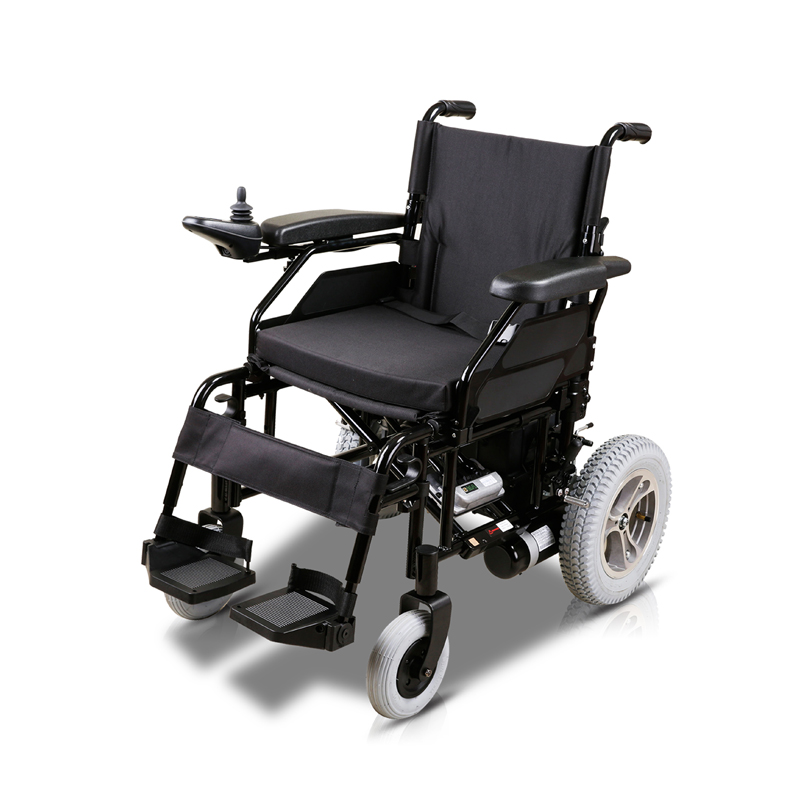
- 14 Product: iFold PLUS Automatic folding electric wheelchair with joystick controller hot sale
Mobility equipment should do more than provide movement from one place to another. For many older adults, people with limited mobility, and users who need powered assistance during travel, a wheelchair must also be practical to transport, simple to control, comfortable to use, and dependable in daily conditions. The iFold PLUS automatic folding electric wheelchair has been developed around these expectations. It combines powered mobility with an automatic folding design, a compact transport concept, a dual-side joystick option, suspension, storage, lighting options, and lithium-battery configurations suitable for different travel requirements.
Designed for the travel-smart wheelchair category, this model is particularly suited to users who want the independence of a power wheelchair without the bulk and complicated handling often associated with larger powered devices. It is intended for non-medical use in the United States market. As a mobility product, it should be selected according to the user’s physical needs, local operating rules, terrain, and transportation arrangements.
The product is manufactured by Suzhou Sweetrich Vehicle Industry Technology Co., Ltd., a Chinese mobility equipment company with experience in developing and producing mobility scooters and power wheelchairs. Its manufacturing background, research and development focus, export experience, and attention to product reliability support the practical design of the iFold PLUS. The result is a folding power wheelchair that addresses several common problems at once: difficult lifting, limited storage, awkward controls, restricted travel distance, and insufficient convenience during everyday outings.
Why Folding Design Matters in Modern Mobility
Traditional electric wheelchairs can deliver strong performance, but their size and weight may create challenges when users need to travel by car, store the chair indoors, or move it through a narrow doorway. A rigid frame may require a ramp, a powered vehicle lift, or assistance from another person. Even when a wheelchair offers excellent driving performance, its transport requirements can reduce its practical value for users who frequently visit family, attend appointments, travel to shopping areas, or take holidays.
The automatic folding function of the iFold PLUS is intended to simplify this part of ownership. Rather than requiring the user or caregiver to manually collapse multiple frame components, the chair is designed to fold automatically. This can reduce the number of steps involved in preparing the product for transportation and can make the transition between driving and storage more convenient.
Automatic folding is especially valuable for users who have limited hand strength, reduced balance, or difficulty bending. It may also help caregivers who regularly handle mobility equipment. A folding wheelchair can be placed in a suitable vehicle, stored in a home, or moved through a building with less inconvenience than a larger non-folding model. The exact lifting method and vehicle suitability should always be evaluated before purchase, because the chair still has a meaningful overall weight and should be handled safely.
Once folded, the product is designed to be easier to move. This does not mean that every user will be able to lift it without assistance. The wheelchair weighs 24 kilograms without the battery, and the battery adds additional weight. However, a folding structure can make the product easier to position, roll, store, or transfer compared with a full-size rigid power wheelchair. Users should follow the supplier’s instructions for folding, unfolding, carrying, and battery removal.
The folding concept also improves storage efficiency. In a home environment, a compact folded wheelchair can occupy less floor space than a conventional powered chair. It may be stored in a closet, a vehicle compartment, or another protected area when not in use. For travel businesses, care facilities, and mobility retailers, the folding format can also make inventory handling and showroom presentation more efficient.
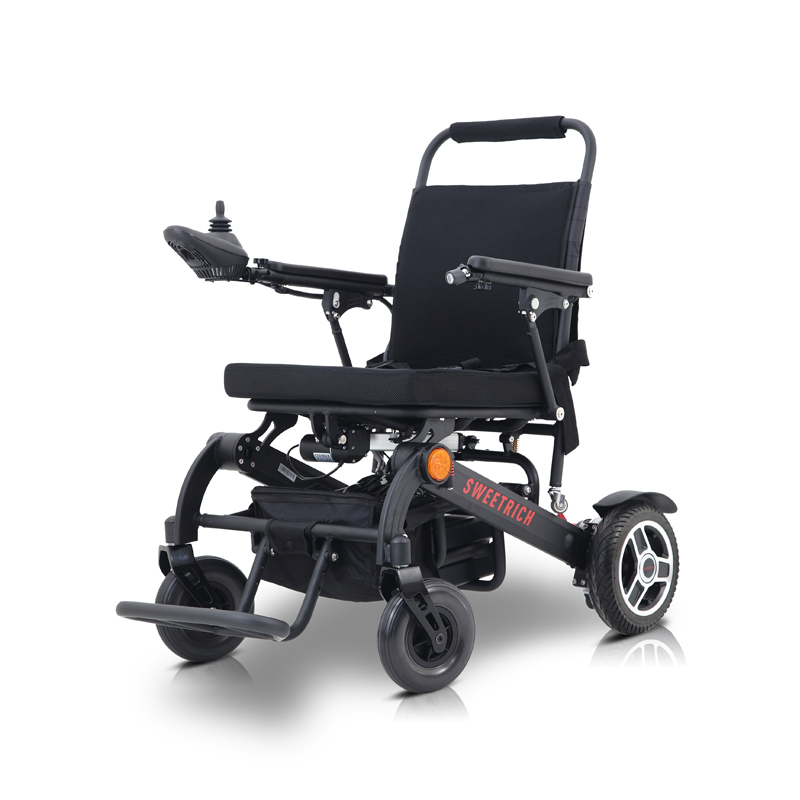
iFold PLUS Automatic folding electric wheelchair with joystick controller hot sale
Core Product Advantages
Automatic Folding for Easier Transport
The most distinctive feature of the iFold PLUS is its automatic folding function. This feature places convenience at the center of the design rather than treating transport as an afterthought. Many users select powered mobility equipment based on how well it performs outdoors, but the equipment must also be moved between locations. A chair that is difficult to store may discourage regular use, even if its driving system is capable.
Automatic folding helps create a smoother routine. The user can drive to a vehicle or storage area, activate the folding system according to the operating instructions, and prepare the wheelchair for transport. Caregivers can also benefit because fewer manual folding operations may reduce handling effort. The design is particularly attractive to active users who want to take a power wheelchair on local trips, family visits, shopping excursions, or leisure journeys.
Practical Travel Orientation
The model belongs to the Travel Smart Wheelchairs category. Its features reflect the requirements of users who want powered mobility in a portable format. The large foot platform supports a more open and practical seating area, while the folding construction helps the user move between indoor storage and outdoor travel. Front and rear suspension contribute to a more controlled ride over appropriate surfaces, and the electromagnetic brake is designed to support secure stopping when the drive system is released.
Travel-oriented mobility does not mean that the product is intended for every surface or every weather condition. Users should operate it on suitable ground, avoid unsafe slopes, and observe all local safety requirements. Nevertheless, the combination of compact handling, powered driving, suspension, and battery operation provides a useful balance for everyday mobility.
Joystick Control on Either Side
The joystick can be installed for use on either side. This is a significant advantage over products that place the control system permanently on only one armrest. Users differ in hand preference, strength, coordination, and seating habits. Some may have greater control on the left side, while others may prefer the right. A dual-side joystick option allows the chair to be configured more appropriately for the individual.
Flexible joystick positioning can also assist users who need to transfer from one side, share space with a caregiver, or adapt the chair to a particular seating arrangement. The control system should be adjusted and tested by a qualified dealer or trained user before regular operation. New users should practice starting, stopping, turning, reversing, and navigating around obstacles in an open, controlled area.
The joystick is more than a convenience accessory. It is the primary interface between the user and the wheelchair’s drive system. A well-positioned control can improve confidence and reduce unnecessary arm movement. It may also help the user maintain a more natural posture while driving. The final setup should account for reach, shoulder movement, seating position, and the user’s ability to release the control quickly.
Efficient Dual-Motor Drive System
The wheelchair uses two 24-volt, 250-watt motors. A dual-motor arrangement provides independent drive power to the left and right sides of the wheelchair, supporting steering and controlled maneuvering. This configuration is widely used in powered wheelchairs because it combines compact packaging with useful torque for daily travel.
The high-performance, high-efficiency motor concept is intended to make effective use of available battery energy. Efficient motors can help reduce unnecessary power consumption during normal driving, although actual range depends on many conditions. Rider weight, terrain, temperature, tire pressure, stopping frequency, speed, battery age, and driving style can all affect performance.
The rated maximum driving gradient is 10 degrees. This figure should not be interpreted as a recommendation to climb every slope with confidence. Slopes should be approached only when the surface is stable, dry, and suitable, and the user should follow the manufacturer’s safety instructions. Uneven ground, wet pavement, loose gravel, cross slopes, and abrupt transitions can create risks even when the incline is below the stated maximum.
Suspension for Greater Ride Control
Front and rear suspension are included to help the wheelchair manage ordinary surface irregularities. Small changes in pavement, thresholds, joints, and other minor imperfections can transmit vibration through a rigid frame. Suspension can help moderate some of these effects and contribute to a smoother ride when the chair is used on appropriate surfaces.
Suspension is also relevant to stability and comfort. A wheelchair that maintains better contact with the ground may feel more predictable during normal travel. However, suspension does not eliminate the need for careful driving. Users should still slow down near curbs, ramps, door thresholds, uneven surfaces, and changes in elevation. The chair is not designed to replace a stair lift or to climb stairs.
Electromagnetic Braking
The iFold PLUS uses an electromagnetic brake system. This braking technology is designed to engage when the drive control is released or when power is interrupted in the appropriate operating condition. It supports controlled stopping during ordinary use and helps prevent unwanted rolling when the wheelchair is not being driven.
Users should understand that an electromagnetic brake is part of a complete safety system rather than a substitute for safe operating habits. The wheelchair should be parked on suitable ground, and users should avoid leaving it unattended on steep slopes. Routine inspection is important. Unusual braking behavior, delayed stopping, noise, or changes in control response should be reported to a qualified service provider before continued use.
Large Foot Platform and Under-Seat Storage
The large foot platform is designed to provide practical support for the user’s feet. A stable foot area can improve comfort during longer periods of sitting and reduce the feeling of having to keep the feet in a narrow position. Users should place both feet correctly and avoid allowing them to extend into the path of the front wheels or surrounding objects.
The under-seat storage bag adds another everyday convenience. Users can carry small personal items, shopping accessories, documents, or other lightweight belongings without needing a separate bag on the lap. Keeping frequently used items under the seat can make short trips easier and reduce the need for a companion to carry basic possessions. Storage should not be overloaded, and items should never interfere with the folding mechanism, wiring, wheels, joystick, or battery compartment.
Optional Front Light
A front light is available as an option. This can improve visibility in dim areas and help make the wheelchair more noticeable to nearby pedestrians. It may be useful in indoor corridors, building entrances, covered walkways, or outdoor areas with limited lighting.
A front light does not automatically make nighttime road travel safe or legal. Users should check local rules concerning powered wheelchairs, visibility equipment, and public-road operation. Reflective clothing, careful speed selection, and awareness of surrounding traffic remain important. The light should be kept clean and checked regularly if it is installed.

Performance and Technical Specifications
The published technical information provides a clear overview of the wheelchair’s intended capabilities. The product has an overall size of 1,090 millimeters in length, 605 millimeters in width, and 998 millimeters in height. These dimensions provide a useful reference when assessing doorway access, indoor turning areas, vehicle compatibility, and storage space.
| Specification | Published Information |
|---|---|
| Product type | Automatic folding electric wheelchair |
| Category | Travel Smart Wheelchairs |
| Overall dimensions | 1,090 × 605 × 998 mm |
| Maximum forward speed | 6 km/h in the technical specification |
| Maximum driving gradient | 10 degrees |
| Maximum driving range | 30 ± 5 km |
| Weight capacity | 120 kg or 265 lb |
| Suspension | Front and rear |
| Tire size | 8 inches front and 10 inches rear |
| Brake system | Electromagnetic brake |
| Battery options | Lithium 24 V/10.2 Ah or 24 V/20 Ah |
| Charger | DC 24 V, 2 A; AC 115–230 V input |
| Charging time | Approximately 5 hours |
| Motor | 24 V/250 W, two motors |
| Motor controller | 24 V/50 A |
| Weight without battery | 24 kg |
The product materials also mention speeds of up to 8.5 kilometers per hour, while the detailed technical table lists a maximum forward speed of 6 kilometers per hour. Because these figures differ, buyers should confirm the applicable speed for the exact configuration, market, controller setting, and battery version before purchase. The technical specification should be treated as the primary reference for evaluation unless the supplier confirms a different certified configuration in writing.
The stated travel range is 30 plus or minus 5 kilometers. This indicates an approximate range rather than a guarantee under every operating condition. A larger-capacity battery may support longer travel, but the actual distance will still be influenced by user weight, slope, surface quality, ambient temperature, tire condition, speed, and repeated acceleration. Users who plan long outings should consider charging access and maintain a safety reserve rather than relying on the maximum stated range.
The battery choices provide flexibility. The 24-volt, 10.2 ampere-hour battery may be appropriate for users who prioritize lighter transport and routine short trips. The 24-volt, 20 ampere-hour option may be more suitable for users who want additional energy capacity. The product materials also refer to an optional battery of up to 30 ampere-hours for greater distance. Availability, compatibility, transport rules, and final range should be confirmed with the supplier or dealer.
The charging system accepts AC input from 115 to 230 volts and provides DC 24-volt, 2-amp output. This broad input range can be useful for different markets, but users must use the correct charger supplied or approved for the wheelchair. Charging should take place in a dry, ventilated location, away from heat sources and combustible materials. Battery terminals, cables, plugs, and the charger housing should be inspected for damage before use.
Advantages Compared with Less Flexible Alternatives
The iFold PLUS is not designed to compete with every type of wheelchair in exactly the same way. A large fixed-frame power wheelchair may offer a different seating system, larger motor capacity, or advanced customization. A lightweight manual wheelchair may be easier to lift. A mobility scooter may provide a different riding posture and storage arrangement. The advantage of the iFold PLUS is its combination of features: powered control, automatic folding, travel-oriented dimensions, a configurable joystick, suspension, and multiple battery choices.
Compared with a manual wheelchair, the product reduces the need for the user or caregiver to provide continuous pushing force. The joystick allows the user to manage forward travel, turning, and reversing independently when properly trained. This can be valuable for people who have sufficient upper-body control but cannot propel a manual chair over longer distances.
Compared with a non-folding power wheelchair, the automatic folding format can simplify transport and storage. The user may not need a permanent vehicle lift or a large dedicated storage area. This can lower the practical barrier to owning powered mobility equipment, particularly for people who live in apartments or regularly use family vehicles.
Compared with a basic folding power chair that has a fixed control position, the dual-side joystick option offers greater adaptability. This feature can be important for users with one-sided weakness, different transfer preferences, or specific arm and shoulder limitations. A product that can be configured to the user may be more useful than one with a lower initial price but fewer adjustment possibilities.
Compared with a small mobility device without suspension, the front and rear suspension can contribute to a more comfortable experience over ordinary uneven surfaces. The larger rear tires and front tires also support the travel design. They do not remove all surface limitations, but they help position the product as a practical powered wheelchair for appropriate daily environments rather than a device intended only for perfectly smooth indoor floors.
The under-seat storage bag and optional front light add value without changing the basic mobility function. These details show attention to ordinary use. A user needs somewhere to keep personal belongings, and visibility can matter when moving through dim spaces. Such features may reduce the need for separate accessories and make the wheelchair more convenient immediately after purchase.
Comfort, Fit, and User Suitability
Performance specifications should always be considered alongside user fit. The weight capacity is 120 kilograms, or 265 pounds. This limit includes the user and any carried items. It should not be exceeded. A buyer should also consider hip width, leg length, posture, arm position, foot placement, and the distance to the joystick. Correct fit can affect comfort, control, stability, and battery performance.
Users should sit with their back properly supported and their feet positioned on the foot platform. Loose clothing, bags, blankets, and other objects should be kept away from moving parts. Before driving, the user should confirm that the joystick is accessible and that the chair is fully unfolded and ready for operation. If the wheelchair includes a safety belt or other restraint supplied by the manufacturer, it should be used as instructed.
People with significant balance limitations, involuntary movements, impaired vision, or difficulty understanding control functions may need an assessment by a qualified healthcare or mobility professional before using a powered wheelchair. The product is described as a non-medical device for the US market, so it should not be represented as a medical treatment or as a substitute for professional assessment.
A dealer or trained technician can help determine whether the seat position, control location, battery selection, and accessories are suitable. A supervised trial is valuable. The user should practice in a quiet space before entering crowded areas. Familiarity with the joystick is particularly important because small control movements may produce a turning or speed response that is different from a manual wheelchair or mobility scooter.

Manufacturing Expertise and Product Development Strengths
The product is produced by Suzhou Sweetrich Vehicle Industry Technology Co., Ltd., a high-tech company located in Suzhou Industrial Zone, Jiangsu, China. Established in 2011, the company has accumulated more than ten years of experience in the research, development, and production of mobility scooters and power wheelchairs. This background is relevant because dependable mobility equipment requires knowledge of mechanical structures, electrical systems, battery integration, user controls, and practical operating environments.
The company operates on a site covering approximately 60 acres and has a factory of about 30,000 square meters. A facility of this scale can support coordinated activities such as product development, component management, assembly, testing, quality control, packaging, and service preparation. The available company information emphasizes strict production management and scientific product design, indicating an organized approach rather than a purely commodity-based manufacturing model.
Research and development is another important strength. Sweetrich owns intellectual property rights for its electric scooters and power wheelchairs. Intellectual property ownership suggests that the company invests in its own product concepts and technical solutions. For buyers and distributors, this can provide confidence that the manufacturer is building a long-term product portfolio instead of relying only on short-term sourcing.
The company states that its products are designed for comfort and incorporate advanced control technology and driving systems. In the iFold PLUS, this design approach can be seen in the integration of automatic folding, joystick operation, dual-motor drive, electromagnetic braking, suspension, and battery options. These functions must work together correctly. A folding wheelchair is not simply a seat attached to wheels; it is a coordinated system in which the frame, motors, controller, battery, wiring, and control interface need to support both mobility and folding operation.
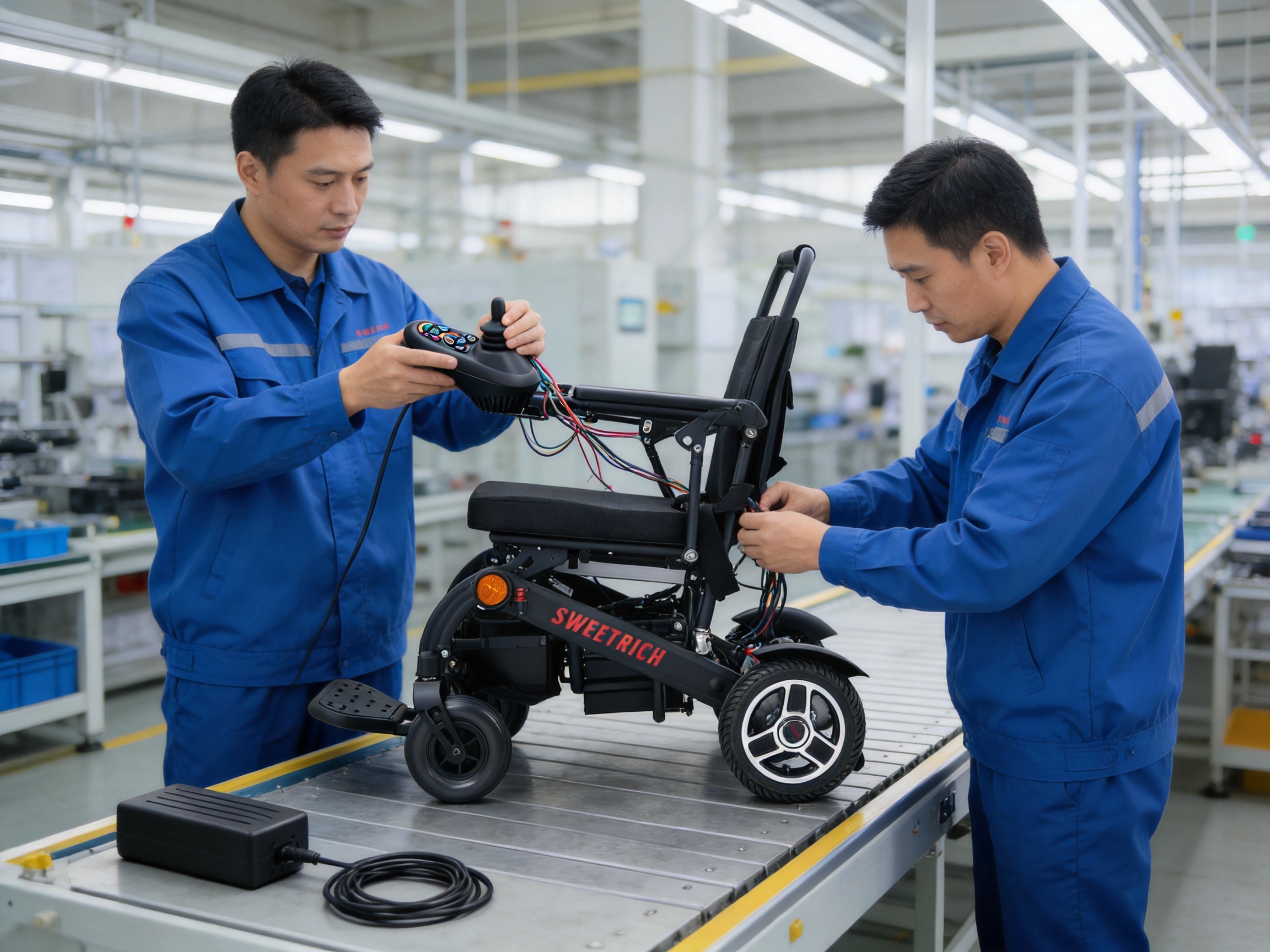
Strict production management is particularly important for an electric wheelchair. Mechanical alignment affects folding and wheel tracking. Electrical assembly affects charging and motor response. Controller calibration affects acceleration, turning, and braking behavior. Battery installation affects weight distribution and reliability. Inspection at different stages can help identify problems before the product reaches the customer. While individual quality depends on the actual manufacturing and inspection procedures used for a specific production batch, the company’s stated focus on quality and reliability is aligned with the requirements of powered mobility equipment.
Manufacturing strength also includes the ability to serve different markets. Sweetrich reports that its products are exported to America, Europe, Japan, Australia, the Middle East, Russia, and other regions. International experience can help a manufacturer understand differences in voltage, documentation, packaging, customer expectations, and distribution requirements. The charger’s 115–230-volt AC input range is one example of a specification that supports use across multiple electrical environments, subject to the correct local configuration and certification requirements.
The company’s stated business principles include quality first, credit above, and customer supreme. For a mobility equipment supplier, these principles should be reflected in practical support: clear specifications, appropriate manuals, spare-parts availability, warranty administration, technical communication, and responsive after-sales service. Distributors should confirm the specific support terms available in their market before placing an order.
Integrated Engineering Rather Than Isolated Features
One of the strongest aspects of the iFold PLUS concept is the relationship between its features. Automatic folding improves portability, but portability is more useful when the chair is also manageable in weight. A joystick is more useful when it can be mounted on the user’s preferred side. A larger battery is more useful when the motor and controller are matched correctly. Suspension is more useful when the tires, frame, and braking system support stable travel.
This type of integration reflects the importance of product engineering. The chair must remain practical in both unfolded and folded conditions. Cables should be routed so that folding does not create unnecessary stress. The battery should be positioned securely. The controller should respond consistently. Moving parts should be protected from interference by bags, clothing, or accessories. These areas are central to long-term user satisfaction and require coordinated design and manufacturing attention.
Quality and Reliability Considerations
Reliability is not defined by one specification alone. It involves consistent assembly, battery performance, structural durability, controller behavior, brake response, wheel alignment, and the availability of service support. Users should inspect the wheelchair when it arrives and report any transport damage or unusual operation promptly. Regular maintenance should include checking tire condition, fasteners, cables, charging connections, folding components, and the condition of the joystick.
Manufacturers and distributors should provide accurate product information, especially where different configurations exist. The speed discrepancy in the supplied materials demonstrates why configuration-specific documentation matters. Buyers should receive clear information about battery capacity, maximum speed, folded dimensions, total transport weight, warranty coverage, charger compatibility, and regional compliance requirements.
Battery Use, Charging, and Range Management
Lithium batteries offer a useful balance of energy capacity and weight for a folding power wheelchair. The available 24-volt configurations allow the product to be matched to different travel patterns. A smaller battery may be preferable when transport weight is the primary concern, while a larger battery may be better for longer outings. The final decision should consider the complete chair weight, not only the battery’s ampere-hour rating.
Range management begins before leaving home. Users should charge the battery fully using the approved charger, check the route, consider slopes and surface conditions, and identify a safe return plan. The advertised range of approximately 30 plus or minus 5 kilometers should be treated as a laboratory or controlled-use reference rather than a promise of distance in all circumstances. Cold weather, repeated hill climbing, high user weight, underinflated tires, and frequent stops can reduce range.
The battery should not be exposed to water, extreme heat, impact, or unauthorized modification. If the wheelchair is stored for an extended period, the owner should follow the manufacturer’s instructions for battery charge level and periodic recharging. Lithium batteries must be transported according to applicable airline, shipping, and local regulations. Users planning air travel should contact the carrier in advance and obtain the battery specifications and transport documentation.
Charging time is listed as approximately five hours. Actual charging time can vary depending on battery condition, remaining charge, temperature, and charger behavior. The charger should be disconnected according to the instructions after charging. Damaged cables, unusual odors, excessive heat, swelling, or abnormal charging behavior require immediate attention from a qualified service provider.
Safe Operation in Daily Environments
New users should begin at low speed in an open, level area. They should learn how the joystick controls acceleration, turning, and reversing before using the chair near pedestrians, vehicles, ramps, or doorways. Sudden joystick movements can cause unexpected direction changes. The user should maintain a safe distance from stairs, drop-offs, open drains, escalators, and moving traffic.
Although the maximum driving gradient is listed as 10 degrees, slope safety depends on more than the angle. A wet, loose, or angled surface may reduce traction. Approaching a slope diagonally can increase the chance of instability. Users should avoid carrying loads that shift the center of gravity and should slow down before entering a decline. The chair should never be used to climb or descend stairs.
The 8-inch front tires and 10-inch rear tires are suitable for the intended travel concept, but tire size does not make every terrain appropriate. Smooth pavement, indoor flooring, accessible pathways, and well-maintained surfaces are generally more appropriate than deep sand, mud, snow, loose gravel, or broken ground. Users should inspect unfamiliar routes and avoid obstacles that could catch the foot platform or affect wheel contact.
Before folding, the user should move the chair to a safe, level location, switch off the power, remove personal items that could interfere with the mechanism, and follow the folding sequence. Hands, feet, clothing, and fingers should be kept away from hinges and moving sections. The chair should not be folded while occupied unless the manufacturer explicitly provides such a function and instructions.
Maintenance and Ownership Benefits
Regular care can help preserve the performance of a powered wheelchair. Tires should be checked for wear, damage, and correct inflation where applicable. Loose fasteners can affect stability and should be addressed promptly. The joystick should remain clean and protected from moisture. The electromagnetic brake should be checked if the chair begins to roll unexpectedly or stop differently from normal.
The folding system deserves special attention. Users should keep the folding path free of bags, straps, dirt, and other obstructions. Any unusual resistance, grinding, incomplete folding, or failure to lock should be treated as a service issue. Forcing the mechanism may create additional damage. The battery and controller should be inspected by authorized personnel rather than opened by an untrained user.
Cleaning should be performed with a soft, slightly damp cloth unless the manual specifies another method. The wheelchair should not be sprayed directly with water or exposed to heavy rain. Moisture can damage electrical components, connectors, and control systems. After outdoor use in damp conditions, the chair should be dried before storage or charging.
Because the chair is designed to fold and travel, owners should also inspect it after transport. Vehicle movement can place stress on wheels, armrests, foot platforms, and folding components if the chair is not secured properly. It should be positioned and restrained according to the supplier’s transport instructions. Heavy objects should not be placed on top of the folded wheelchair.
These maintenance practices are not unique to this model, but the automatic folding design makes them especially relevant. A folding mobility product must remain reliable through repeated cycles of driving, folding, unfolding, loading, storage, and charging. Proper care protects the user’s investment and supports safer daily operation.
Choosing the Right Configuration
The best configuration depends on the user’s routine. Someone who primarily travels indoors and makes short local trips may prefer the lighter battery option. Someone who frequently spends several hours outdoors may value the higher-capacity battery. A user with limited right-arm function may benefit from a left-side joystick arrangement. Another user may prefer right-side control based on habit or transfer position.
Buyers should measure the spaces where the wheelchair will be used. Door widths, elevator dimensions, vehicle openings, storage areas, and turning spaces can all affect suitability. The listed width is 605 millimeters, but buyers should also ask for folded dimensions if those are not included in the sales documentation. The total weight with the selected battery should be confirmed before planning vehicle loading.
Professional assessment is recommended when the user has complex posture, seating, transfer, or control requirements. A distributor can often help compare battery options, accessory packages, charger versions, and regional documentation. The final configuration should be recorded clearly on the order and in the product manual.
Frequently Asked Questions
Is the iFold PLUS a medical device?
The product materials describe it as a non-medical device for the United States market. It is a powered mobility product intended to support movement and travel. It should not be presented as a treatment device or as a replacement for professional medical advice, rehabilitation assessment, or a properly fitted clinical mobility system.
How does the automatic folding function benefit users?
It can reduce the number of manual steps required to prepare the wheelchair for transport and storage. This may benefit users and caregivers who have limited strength or difficulty handling a rigid power wheelchair. The product should still be folded and unfolded only according to the manufacturer’s instructions, and the user should keep hands and clothing away from moving parts.
What is the maximum speed?
The detailed specification lists a maximum forward speed of 6 kilometers per hour. Other product materials mention speeds up to 8.5 kilometers per hour. Because these figures conflict, customers should confirm the approved speed of the exact model and configuration with the supplier before purchase. Local rules may also limit where and how a powered wheelchair can be operated.
How far can it travel on one charge?
The published driving range is approximately 30 plus or minus 5 kilometers. Actual range varies with battery capacity, rider weight, terrain, slope, temperature, tire condition, speed, and driving style. Users should plan trips conservatively and avoid depending on the maximum stated distance without a charging or return plan.
What battery options are available?
The listed options include lithium batteries rated at 24 volts and 10.2 ampere-hours or 20 ampere-hours. The product information also refers to an optional battery of up to 30 ampere-hours for greater distance. Availability and compatibility should be confirmed for the intended market and specific wheelchair configuration.
Can the joystick be installed on either side?
Yes. The product features a joystick option for use on both sides. This allows the control position to be selected according to the user’s preference, hand function, transfer needs, and seating arrangement. Installation and adjustment should be performed correctly before operation.
What is the wheelchair’s weight capacity?
The published weight capacity is 120 kilograms, or 265 pounds. This limit includes the user and carried items. The product should not be used above this capacity. Users should also consider how additional load affects braking, stability, folding, and battery range.
How heavy is the wheelchair?
The listed weight without the battery is 24 kilograms. The complete transport weight will be higher once the selected battery and accessories are included. Buyers should confirm the final weight and determine whether they need assistance or a vehicle loading solution.
Is a front light included?
A front light is available as an option. It may improve visibility in dim environments, but it does not make all nighttime or roadway use safe or legal. Users should follow local regulations and use additional visibility precautions where appropriate.
What kind of surfaces are suitable?
The wheelchair is intended for appropriate indoor and outdoor surfaces such as smooth floors, accessible paths, and well-maintained pavement. Users should avoid stairs, deep sand, mud, loose gravel, severe uneven ground, and unsafe slopes. Suspension improves ride control over suitable minor irregularities but does not eliminate terrain limitations.
How long does charging take?
The charging time is listed as approximately five hours. Actual time may vary with battery condition and remaining charge. The approved charger should be used in a dry, ventilated area, and the user should follow all battery and charger instructions.
Who manufactures the product?
The product is manufactured by Suzhou Sweetrich Vehicle Industry Technology Co., Ltd., a mobility equipment company established in 2011 in Suzhou, Jiangsu, China. The company develops and produces mobility scooters and power wheelchairs and reports export experience in America, Europe, Japan, Australia, the Middle East, Russia, and other markets.
Conclusion
The iFold PLUS automatic folding electric wheelchair is designed for users who want powered independence without giving up transport convenience. Its automatic folding system addresses one of the most common barriers associated with electric wheelchairs: the difficulty of moving and storing a large rigid device. The dual-side joystick option improves personalization, while the dual 250-watt motors, electromagnetic brake, front and rear suspension, large foot platform, under-seat storage, optional front light, and lithium-battery choices create a practical package for everyday travel.
Its strongest advantage over simpler alternatives is the balance between mobility and portability. It is more independent than a manual chair, more transport-oriented than many fixed-frame power wheelchairs, and more adaptable than models with a permanently positioned joystick. The product also benefits from the manufacturing background of Suzhou Sweetrich Vehicle Industry Technology Co., Ltd., including its research and development experience, intellectual property, factory resources, international market exposure, and stated commitment to quality and customer service.
Prospective users should confirm the exact speed, battery version, folded dimensions, total weight, warranty, local compliance, and service arrangements before ordering. With proper configuration, responsible driving, suitable maintenance, and realistic range planning, the iFold PLUS can provide a convenient mobility solution for users seeking greater independence during local travel, storage, and everyday activities.
References
1. Product specification materials for the iFold PLUS automatic folding electric wheelchair, including dimensions, motor, battery, controller, braking, suspension, speed, range, and capacity data.
2. Suzhou Sweetrich Vehicle Industry Technology Co., Ltd. company profile and manufacturing information.
3. General user guidance for powered wheelchairs, including battery charging, safe slope operation, joystick training, transport, and routine maintenance.
4. General principles of lithium-battery handling and transport for powered mobility equipment.
5. General accessibility and mobility-equipment safety practices for indoor and outdoor travel.