 info@sweetrich.cn
  +86-(0)512-82283871
Content
- 1 Introduction
- 2 1. Product Overview and Intended Use
- 3 2. Key Specifications at a Glance
- 4 3. Compact Four-Wheel Design
- 5 4. Foldability and Travel Convenience
- 6 5. Motor, Controller, and Driving Performance
- 7 6. Battery Configuration and Charging
- 8 7. Electromagnetic Braking and Control
- 9 8. Rear Suspension and Tire Arrangement
- 10 9. Weight Capacity and User Fit
- 11 10. Advantages Compared with Common Alternatives
- 12 11. Manufacturing Experience and Company Strengths
- 13 12. Advanced Manufacturing Considerations
- 14 13. Comfort, Independence, and Daily Use
- 15 14. Safety and Responsible Operation
- 16 15. Maintenance and Service Planning
- 17 16. Purchasing and Ownership Considerations
- 18 17. Frequently Asked Questions
- 18.1 Q1: What type of mobility scooter is the S1 Sport?
- 18.2 Q2: Is the S1 Sport a medical device?
- 18.3 Q3: What is the maximum speed?
- 18.4 Q4: How far can it travel on one charge?
- 18.5 Q5: What battery does the scooter use?
- 18.6 Q6: How long does charging take?
- 18.7 Q7: How heavy is the scooter?
- 18.8 Q8: What is the maximum user weight?
- 18.9 Q9: Does the scooter have suspension?
- 18.10 Q10: What type of brake does it use?
- 18.11 Q11: Is the scooter suitable for steep hills?
- 18.12 Q12: What makes it different from a larger mobility scooter?
- 18.13 Q13: Can it be placed in a car?
- 18.14 Q14: Is it suitable for outdoor use?
- 18.15 Q15: What should buyers ask the manufacturer or distributor?
- 19 Conclusion
- 20 References
- 21 Product: S1 Sport Easy Travel 4 Wheel Ultra Light Foldable Electric Mobility Scooter for Old People
Introduction
Modern mobility scooters are designed to help people travel more independently while reducing the physical effort required for everyday movement. For older adults, people with limited mobility, and users who want a convenient travel solution, a scooter must offer more than electric power alone. It should be easy to operate, stable on suitable surfaces, practical to transport, comfortable during regular use, and simple to maintain.
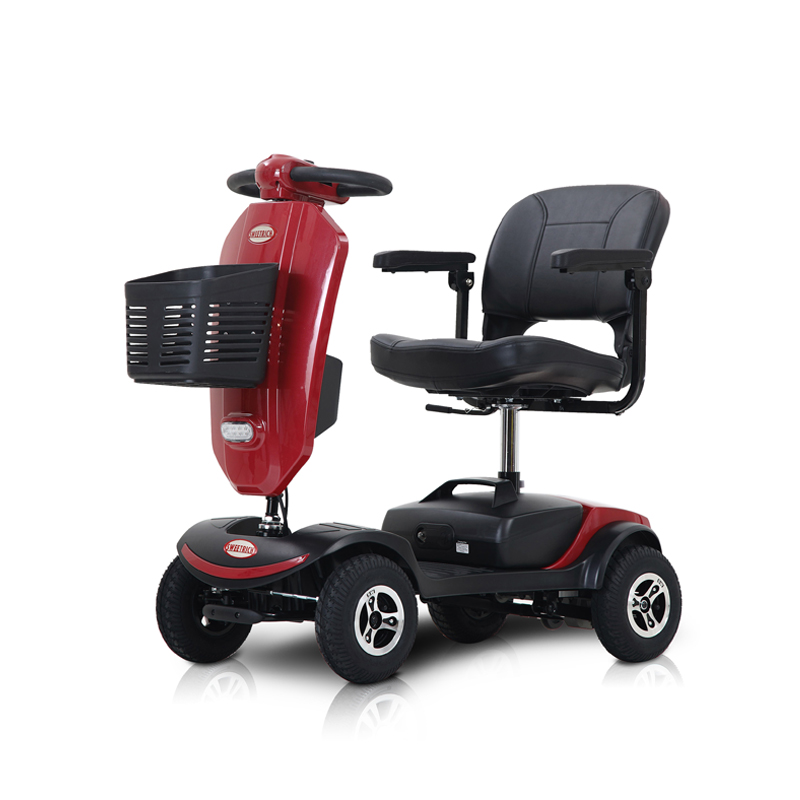
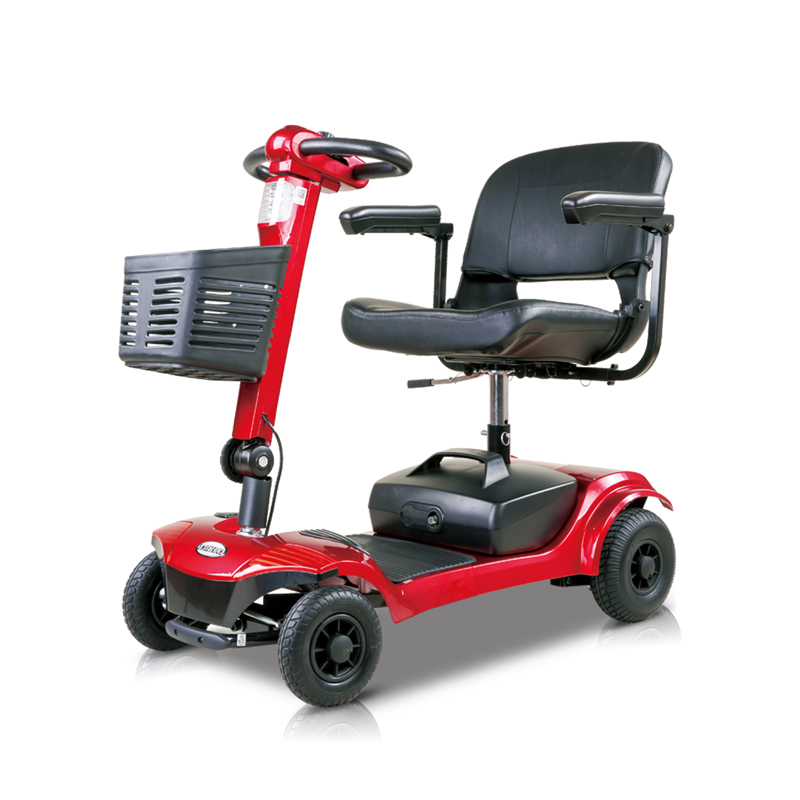
The S1 Sport Easy Travel 4 Wheel Ultra Light Foldable Electric Mobility Scooter is designed around these priorities. It belongs to the Travel Smart Scooters category and combines a compact four-wheel layout with a foldable structure, a 24V electric drive system, electromagnetic braking, rear suspension, and a maximum forward speed of 8 km/h, or approximately 5 miles per hour. Its claimed driving range is between 15 and 25 km, depending on configuration and operating conditions.
Unlike large, heavy-duty mobility scooters intended primarily for long outdoor journeys, the S1 Sport is positioned as a portable and travel-oriented model. Its dimensions, removable or manageable component design, and 27 kg heaviest-part specification make it more suitable for users and families who need to place a scooter in a vehicle, move it through a building, or store it at home.
The scooter is identified as a non-medical device intended for the United States market. It should therefore be understood as a personal mobility product rather than a medical treatment device. Users should consider their own mobility requirements, local transportation regulations, terrain conditions, and the availability of assistance before purchase.
This article examines the product’s design, performance, travel advantages, safety features, technical specifications, and manufacturing background. It also explains how the S1 Sport compares with common alternatives and why its combination of portability and functional capability may appeal to users seeking a practical everyday mobility solution.
S1 Sport Easy Travel 4 Wheel Ultra Light Foldable Electric Mobility Scooter for Old People
1. Product Overview and Intended Use
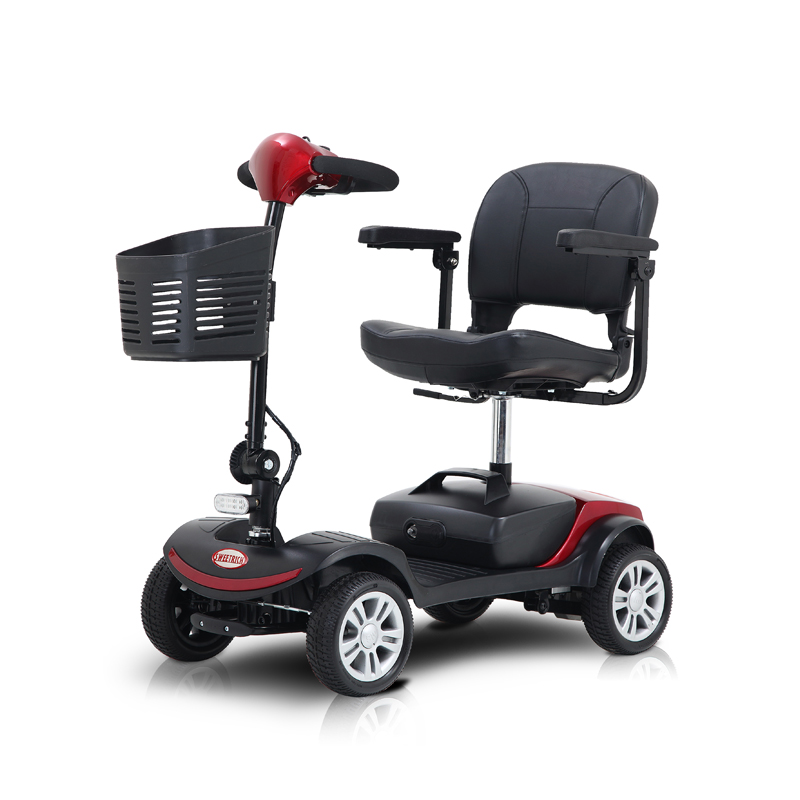
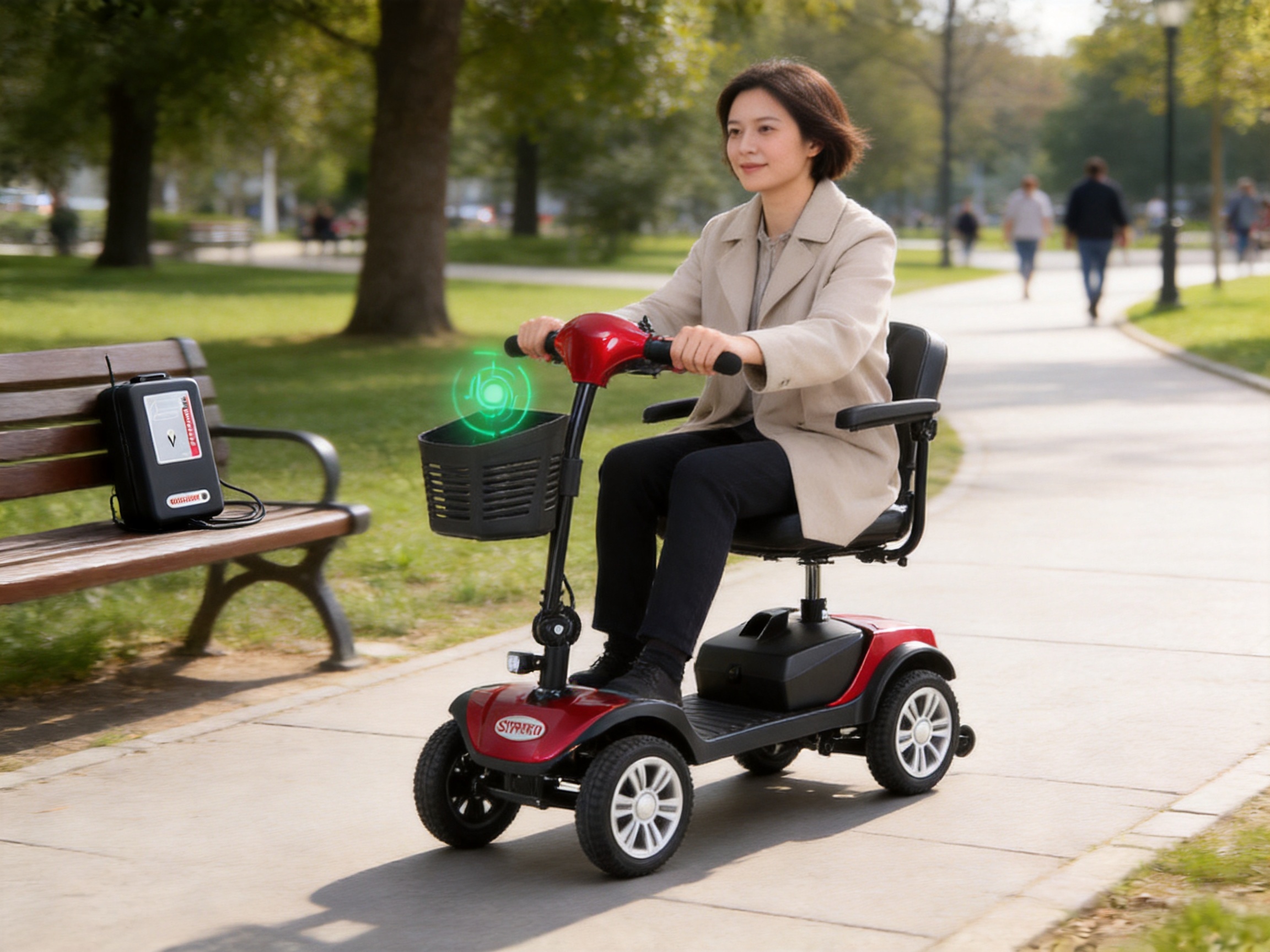
The S1 Sport is a four-wheel electric mobility scooter developed for travel-oriented use. Its structure is intended to provide a balance between compactness and stability. Four wheels generally create a broader support footprint than a three-wheel configuration, which can be useful for users who prefer a more planted feeling during low-speed turns and regular movement on smooth, appropriate surfaces.
The product has a listed overall size of 1110 mm in length, 525 mm in width, and 920 mm in height. In imperial terms, this is approximately 43.7 inches long, 20.7 inches wide, and 36.2 inches high. These dimensions make the scooter relatively narrow compared with many full-size outdoor mobility scooters. A narrower body can be helpful when moving through residential doorways, hallways, elevators, shopping areas, and other confined spaces.
The S1 Sport is described as foldable and ultra light for its category. The term “ultra light” should be interpreted in relation to comparable electric mobility scooters, not as meaning that every component can be lifted effortlessly by every user. The specification lists the heaviest part as 27 kg, or approximately 60 pounds. This distinction is important because transport may still require two people, a loading aid, or careful planning depending on the user’s strength and vehicle height.
The scooter is suited to everyday trips such as moving around a home, visiting shops, traveling through suitable public spaces, and making short recreational journeys. It may also be useful for users who need a scooter that can be stored when not in operation. Its intended role is convenience and personal mobility, not high-speed transportation or rough-terrain performance.
Because the S1 Sport is categorized as a non-medical device, it does not replace a professional mobility assessment. A prospective user should determine whether the seat, control layout, turning behavior, maximum load, and braking characteristics meet individual needs. People with significant balance, vision, coordination, or strength limitations may need guidance from a qualified professional before using any powered mobility product.
2. Key Specifications at a Glance
The specifications provide a useful starting point for understanding the scooter’s capabilities. They describe a compact electric vehicle powered by a 24V, 300W motor and controlled by a dynamic 24V, 50A controller. The system is supported by lead-acid batteries and a charger designed for 100–240V AC input.
| Specification | Listed Detail | Practical Meaning |
|---|---|---|
| Product type | Four-wheel foldable electric mobility scooter | Designed for portable personal mobility and travel-oriented use |
| Dimensions | 1110 × 525 × 920 mm | Compact footprint for suitable indoor and outdoor locations |
| Maximum forward speed | 8 km/h, approximately 5 mi/h | Appropriate for controlled low-speed travel |
| Maximum driving gradient | 10 degrees | Suitable only for slopes within the user’s ability and safe operating conditions |
| Maximum driving range | 15–25 km, approximately 9.5–15.5 miles | Range varies according to battery option, load, terrain, temperature, and driving behavior |
| Weight capacity | 120 kg, approximately 265 lb | Maximum stated user and carried-load capacity |
| Suspension | Rear suspension | Helps moderate vibration on suitable paved surfaces |
| Tire size | 9 × 3 inches front and rear | Provides a consistent four-wheel contact arrangement |
| Brake system | Electromagnetic brake | Supports controlled stopping when the drive system is released |
| Battery | Lead-acid, 12V 12Ah or 20Ah × 2; 20Ah optional | Battery configuration affects range, weight, and charging requirements |
| Charger | DC 24V 2A, AC 100–240V | Designed for broad mains-voltage compatibility with the correct adapter and outlet |
| Charging time | Approximately 6 hours | Overnight charging may be convenient for many users |
| Motor | 24V, 300W | Provides low-speed electric propulsion for intended operating conditions |
| Motor controller | 24V, 50A dynamic | Manages electrical power and motor response |
| Heaviest part | 27 kg, approximately 60 lb | Relevant for vehicle loading, stairs, and storage planning |
Specifications should always be considered together rather than individually. For example, the maximum range cannot be evaluated without considering battery capacity, rider weight, slope, surface quality, temperature, tire condition, and speed. Similarly, the stated maximum gradient does not mean that every user should attempt that gradient. Safe operation depends on traction, surface condition, turning angle, battery charge, rider confidence, and local guidance.
3. Compact Four-Wheel Design
One of the S1 Sport’s primary advantages is the combination of a four-wheel chassis and a compact body. Four wheels can provide a reassuring sense of stability for users who prefer a balanced platform. The arrangement also distributes the scooter’s load across multiple contact points, which can support predictable movement on smooth, level ground.
Compared with many three-wheel scooters, a four-wheel model may feel more secure during straight-line travel and gentle changes of direction. This can be especially valuable for users who prioritize confidence over a very tight turning circle. However, four-wheel scooters may require more space for certain turns than three-wheel designs. The S1 Sport’s relatively narrow 525 mm width helps offset this limitation in indoor and travel environments.
The compact width is practical in everyday settings. Users may find it easier to approach a doorway, line up with an elevator, pass through a corridor, or position the scooter beside a table. Families may also appreciate a smaller storage footprint in an apartment, garage, or vehicle compartment.
The 1110 mm length contributes to a manageable overall profile. A compact length can help with parking and maneuvering, although users should still practice turning and reversing in an open area before entering crowded environments. A scooter should be operated at a speed appropriate to the surroundings, especially near pedestrians, ramps, doors, and uneven transitions.
4. Foldability and Travel Convenience
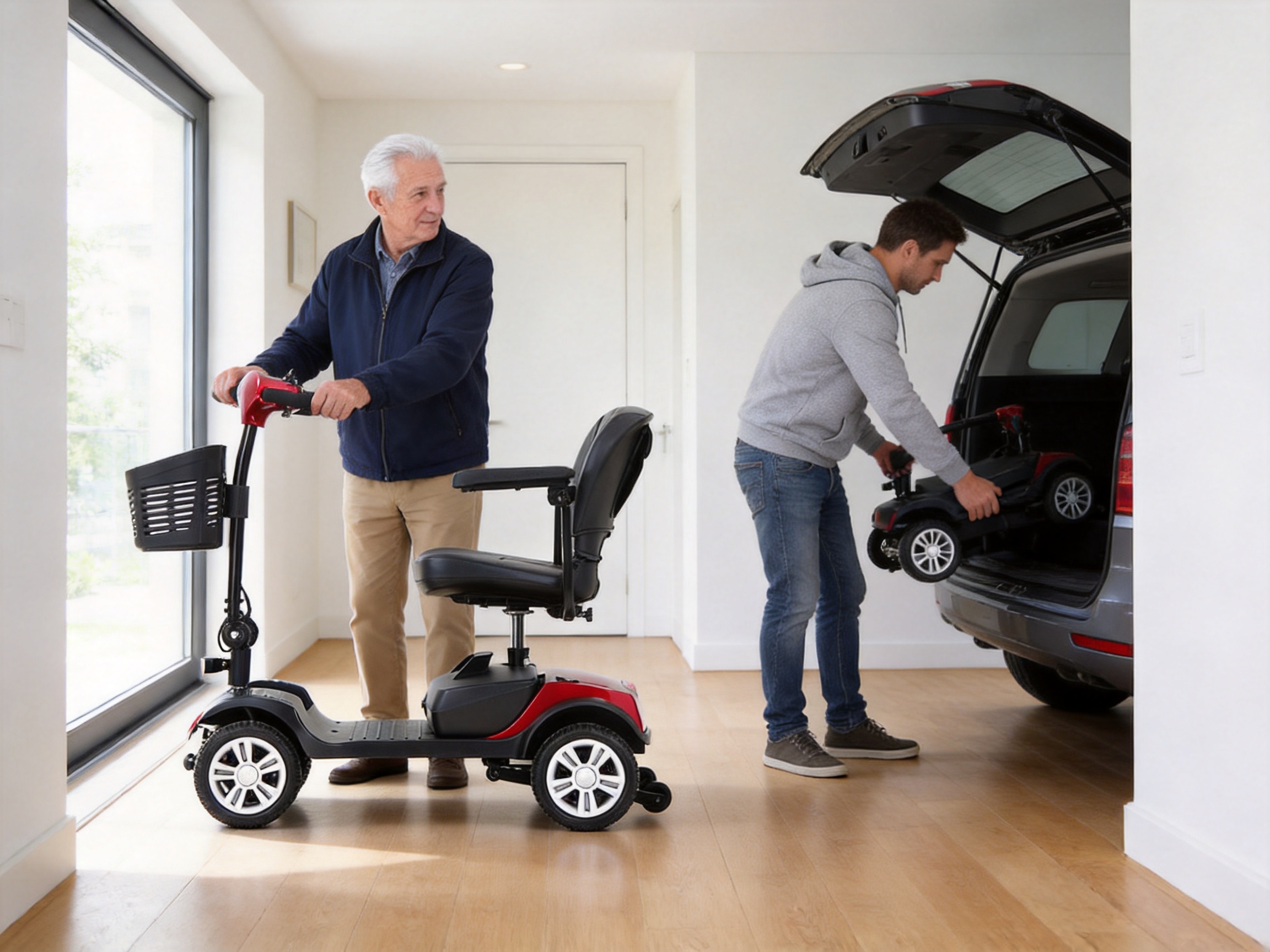
Foldability is a central feature of the S1 Sport. A foldable mobility scooter can offer advantages over fixed-frame alternatives for people who frequently travel by car or need to store their scooter between uses. When folded or prepared for transport according to the manufacturer’s instructions, the scooter may occupy less space than a full-size rigid mobility vehicle.
This makes the product attractive to households with limited storage. It can potentially be positioned in a vehicle, utility area, closet, or other suitable location when not being used. A portable design may also reduce the need for permanent outdoor parking, which can help protect the scooter from weather exposure.
Nevertheless, portability should be evaluated realistically. The heaviest component weighs 27 kg, so users should consider whether they can safely lift it into a trunk or cargo area. A folding mechanism reduces size but does not eliminate weight. Some users may benefit from a second person, a loading ramp, a vehicle hoist, or a vehicle with a low loading height.
Before travel, the folding structure should be fully secured in both its operating and transport positions. Users should inspect latches, hinges, locking points, cables, and battery connections as recommended in the product documentation. The scooter should never be operated unless the frame is completely unfolded and securely locked.
Compared with larger competitors, the S1 Sport’s travel-oriented format may simplify occasional transportation. Compared with very small three-wheel travel scooters, its four-wheel design may provide a more confidence-inspiring platform. This balance between portability and stability is one of the product’s most important competitive strengths.
5. Motor, Controller, and Driving Performance
The scooter uses a 24V, 300W motor. This power level is appropriate for a compact, low-speed mobility scooter intended for controlled travel on suitable paved surfaces. The motor is not designed to compete with high-performance outdoor scooters built for extended off-road use, but it provides a practical propulsion system for its intended role.
The maximum forward speed is listed as 8 km/h, or about 5 miles per hour. This speed allows the user to move at a steady walking pace while maintaining a manageable level of control. In busy indoor areas, narrow paths, entrances, and pedestrian zones, users should reduce speed well below the maximum.
The listed motor controller is a 24V, 50A dynamic unit. The controller regulates the relationship between the battery, throttle or control input, and motor. Smooth control response is especially important for users who may be uncomfortable with sudden acceleration or abrupt changes in speed. A well-matched controller can support predictable starts and stops when the scooter is used correctly.
Performance will vary according to the user’s weight, battery condition, surface, tire pressure, incline, wind, temperature, and driving habits. A scooter may travel more slowly when climbing, carrying a heavier load, or operating on rough or soft ground. The stated specifications should therefore be treated as reference values rather than guaranteed results in every environment.
The maximum driving gradient is listed as 10 degrees. This figure should not be confused with a recommendation to climb every available slope. A slope can become hazardous when it is wet, loose, narrow, uneven, or angled across the direction of travel. Users should approach gradients directly where appropriate, avoid sudden turns, maintain a safe speed, and follow the operating instructions supplied with the scooter.
6. Battery Configuration and Charging
The S1 Sport uses two 12V lead-acid batteries. The listed configuration is 12Ah, with 20Ah available as an option. Battery capacity has a direct effect on expected range, and the higher-capacity option may be considered by users who need longer trips between charging sessions.
Lead-acid batteries are widely used in mobility equipment because they are established, readily understood, and generally economical compared with some newer battery technologies. They do, however, have specific charging and maintenance requirements. Users should use the correct charger, allow the charging cycle to finish, and avoid storing the batteries in unsuitable temperatures or conditions.
The charger is specified as DC 24V 2A with AC 100–240V input. This broad input range may support use in different electrical environments when the correct plug arrangement and local safety requirements are observed. Users should confirm that the charger supplied with their individual unit is suitable for the intended country and outlet.
Charging time is listed as approximately six hours. Many users may find it convenient to charge the scooter overnight after a day of travel. The exact time can vary with battery condition, remaining charge, temperature, charger behavior, and battery capacity. A battery should not be left in an unsafe location while charging, and ventilation requirements should be followed.
The stated maximum range is 15–25 km, or approximately 9.5–15.5 miles. This range should be viewed as an estimated operating interval rather than a fixed distance. A heavier user, steep route, frequent stopping, cold weather, low tire pressure, or aged batteries may reduce the distance available from one charge.
For reliable travel, users should plan a reserve rather than deliberately exhausting the battery. It is sensible to charge before a long journey, understand the route, and carry relevant contact information or assistance options. Battery performance should be checked regularly, particularly if the scooter has been stored for a long period.
7. Electromagnetic Braking and Control
The S1 Sport is equipped with an electromagnetic brake system. This type of brake is commonly used in electric mobility vehicles because it can engage when the drive control is released or when electrical power is interrupted, subject to the design of the specific controller and operating system.
Electromagnetic braking can be convenient for users because it reduces the need to operate a separate manual brake lever during routine driving. The system is integrated with the electric drive system, allowing the scooter to slow and stop in response to control input.
Even with an electromagnetic brake, users must operate responsibly. Braking distance depends on speed, rider weight, slope, surface condition, tire grip, battery and controller condition, and reaction time. Users should maintain additional distance around pedestrians, furniture, vehicles, curbs, and other obstacles.
A brake system should be tested in a safe, open area before regular use. If the scooter rolls unexpectedly, stops inconsistently, makes unusual noises, or behaves differently from normal, it should be taken out of service until inspected by an appropriate technician. The braking system should not be modified without authorized technical guidance.
The combination of low maximum speed and electromagnetic braking supports controlled operation in the environments for which the scooter is designed. It does not make the scooter suitable for roads, steep uncontrolled slopes, or hazardous surfaces. Users should follow local rules and the product manual at all times.
8. Rear Suspension and Tire Arrangement
The product includes rear suspension and 9 × 3 inch tires at both the front and rear. Suspension can help reduce the transmission of vibration through the frame when traveling over suitable paved surfaces. This may make routine trips more comfortable than using a completely rigid frame on the same surface.
Rear suspension does not turn the S1 Sport into an off-road vehicle. The scooter remains a compact travel model, and its performance is best evaluated on smooth, stable, and reasonably maintained paths. Deep potholes, loose gravel, mud, sand, standing water, and abrupt curbs can reduce control and increase the risk of damage or tipping.
The same tire dimensions front and rear provide a consistent footprint and contribute to the scooter’s balanced appearance. Tire condition is important to both comfort and safety. Users should inspect tires for excessive wear, cuts, embedded objects, and abnormal pressure where applicable. Correct tire maintenance can help preserve steering response, braking behavior, and battery efficiency.
When crossing thresholds or small surface changes, users should approach slowly and as directly as practical. They should avoid crossing steep side slopes or turning sharply while one wheel is on a raised surface. Good driving technique is as important as the mechanical design of the scooter.
9. Weight Capacity and User Fit
The listed weight capacity is 120 kg, or approximately 265 pounds. This figure should include the user and any carried items placed on the scooter. Staying within the rated capacity is essential for maintaining safe handling, braking, structural performance, and expected range.
Users should consider more than weight alone when evaluating fit. Seat dimensions, steering position, foot placement, control reach, posture, and the ability to transfer safely onto and off the scooter are all important. A product that meets the weight requirement may still be unsuitable if the user cannot operate the controls comfortably.
Caregivers and family members should allow the user to practice in a controlled area. Training should include starting, stopping, reversing, turning, approaching a doorway, managing a gentle slope, and parking. The user should also learn how to respond if the battery becomes low or if an obstacle blocks the route.
Because the scooter is not a medical device, it should not be selected as a substitute for clinical advice. Individuals with particular seating, posture, or support needs may require a different mobility product. A professional assessment can help determine whether a compact scooter is appropriate.
10. Advantages Compared with Common Alternatives
10.1 Compared with Full-Size Outdoor Scooters
Full-size outdoor scooters often provide larger batteries, greater ground clearance, broader seats, and more substantial suspension. These features can be valuable for long-distance or demanding outdoor use, but they also increase weight, storage requirements, turning space, and transportation difficulty.
The S1 Sport offers a different set of priorities. Its compact dimensions and foldable structure make it easier to consider for users who travel by car, live in smaller homes, or need a scooter for shopping centers, indoor facilities, and paved local routes. The product may be a better match for portability-focused users who do not need the size and power of a heavy outdoor model.
10.2 Compared with Three-Wheel Travel Scooters
Three-wheel scooters are often valued for their tight turning circles and maneuverability. However, some users prefer the more balanced feel of four wheels. The S1 Sport’s four-wheel configuration can offer a stable platform while retaining a relatively narrow body.
This design may appeal to users who want a travel scooter but do not want to sacrifice the reassuring footprint associated with four wheels. The trade-off is that the scooter may require more space for certain turns than a three-wheel model. A test drive is recommended whenever possible.
10.3 Compared with Non-Folding Scooters
A rigid scooter may be structurally straightforward, but it can be inconvenient to transport and store. The S1 Sport’s folding capability directly addresses this limitation. Users can plan for vehicle travel and indoor storage without committing to the footprint of a permanent full-size mobility vehicle.
Its heaviest-part specification also provides useful transport information. Rather than judging portability only by the word “foldable,” buyers can assess whether a 27 kg component is manageable for their household. This makes the product’s travel proposition more transparent and practical.
10.4 Compared with Manual Mobility Options
A powered scooter can reduce the physical effort associated with pushing a manual mobility device over suitable distances. The S1 Sport’s 300W motor, rechargeable battery, and electromagnetic brake system are designed to provide self-propelled movement for users who can safely operate the controls.
At the same time, a powered scooter requires battery charging, electrical maintenance, and responsible driving. It is not automatically preferable for every person or environment. Its advantage is most apparent when electric propulsion and compact travel convenience match the user’s needs.
11. Manufacturing Experience and Company Strengths
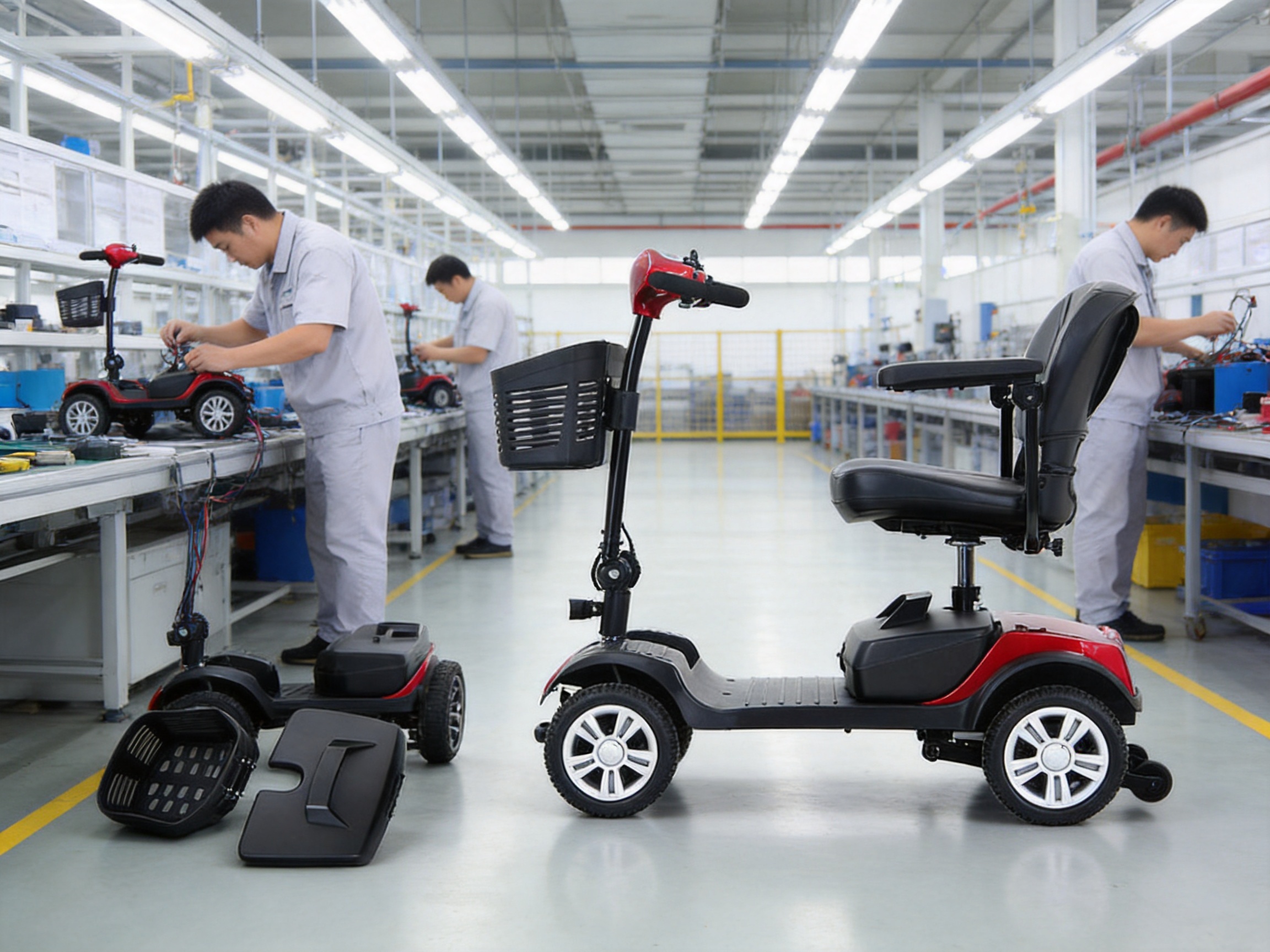
The S1 Sport is produced by Suzhou Sweetrich Vehicle Industry Technology Co., Ltd., a high-tech mobility equipment company located in Suzhou Industrial Zone, Jiangsu, China. The company was established in 2011 and has accumulated more than ten years of experience in the research, development, and production of mobility scooters and power wheelchairs.
The company reports a 60-acre operating area and a 30,000-square-meter factory. These facilities provide a foundation for organized product development, component management, assembly, testing, and quality control. A dedicated manufacturing environment can help a company coordinate engineering knowledge with production experience instead of treating each product as an isolated project.
Sweetrich focuses on mobility scooters and power wheelchairs, allowing it to build specialized understanding of electric drive systems, vehicle frames, control technologies, braking systems, seating arrangements, and user-oriented design. Concentration in a specific product field can support more informed design decisions than a purely general manufacturing approach.
The company states that it owns intellectual property rights for its electric scooters and power wheelchairs. Intellectual property development can indicate an effort to create proprietary product solutions rather than simply reproduce standard market designs. For a travel scooter, such development may involve folding mechanisms, frame arrangement, control integration, battery placement, and compact packaging.
Sweetrich also describes advanced control technology and driving systems intended to support smooth and safe operation. In practical terms, control quality depends on the interaction among the motor, controller, throttle, electromagnetic brake, wiring, battery, and mechanical frame. Reliable performance requires these systems to be designed and assembled as a coordinated whole.
The company emphasizes strict production management and scientific product design. These principles are relevant to mobility equipment because small inconsistencies in assembly can affect steering, braking, folding security, electrical reliability, and user confidence. Systematic procedures can help reduce variation and support repeatable product quality.
International experience is another company strength. The company reports that its products are exported to America, Europe, Japan, Australia, the Middle East, Russia, and other markets. Serving multiple markets requires attention to different customer expectations, transportation conditions, product configurations, electrical environments, and regulatory considerations.
For buyers and distributors, a manufacturer with established export experience may offer advantages in communication, product documentation, packaging, spare-parts coordination, and after-sales cooperation. These factors do not replace verification of a specific model, but they can be important when evaluating long-term supplier capability.
12. Advanced Manufacturing Considerations
Manufacturing a foldable electric mobility scooter involves more than assembling a motor onto a frame. The folding structure must balance compactness with strength. Hinges and locking points must be positioned to support repeated folding and unfolding. Electrical cables must be routed so that movement does not cause abrasion or excessive stress. Batteries must be secured, and the controller must communicate reliably with the motor and braking system.
Frame production is a fundamental stage. The frame must support the rated load while maintaining alignment between the wheels, steering column, seat structure, and folding components. Accurate welding, fastening, and dimensional control can contribute to predictable handling and reduced mechanical noise.
Electrical integration is equally important. The battery system, charger connection, controller, motor, brake, and user control interface must work together. A professional manufacturing process typically includes inspection of wiring connections, polarity, insulation, component placement, and operational response. These checks are especially relevant for a compact design in which multiple systems must fit within a limited space.
Quality management should also address the folding function. A scooter may look compact when folded, but its practical value depends on whether the user can operate the mechanism safely and consistently. Assembly teams need to confirm that locks engage properly, moving parts have appropriate clearances, and the unfolded frame remains secure during use.
Product testing can include visual inspection, functional operation, charging checks, brake response, steering behavior, load-related assessment, and packaging review. The exact procedures and standards applied to a particular product should be confirmed with the manufacturer or distributor. Buyers should request relevant documentation when required by their market or purchasing process.
Sweetrich’s stated emphasis on strict production management, research and development, and scientific product design supports the idea of a process-oriented manufacturing approach. Its factory scale and specialized product focus may help the company maintain coordinated development from early design through production and export.
13. Comfort, Independence, and Daily Use
A mobility scooter’s value is measured not only by technical figures but also by how naturally it fits into daily life. The S1 Sport is designed to help users complete suitable trips without relying entirely on another person for propulsion. This can support a greater sense of independence in shopping, visiting, social activities, and movement around appropriate facilities.
The compact body may make it easier to position the scooter in familiar environments. A user can potentially approach a counter, wait in a designated area, or move through an indoor space without the large turning area required by a full-size model. The four-wheel arrangement provides a stable-feeling base for routine low-speed travel.
Rear suspension may contribute to comfort on smooth paved routes by reducing some vibration. However, comfort also depends on seat design, posture, clothing, route condition, speed, and correct adjustment. Users should take breaks during longer outings and avoid assuming that a compact scooter is suitable for unlimited continuous travel.
Independence also requires preparation. Users should know how far the scooter can travel under their usual conditions, where charging is available, and what to do if the battery becomes low. They should carry essential personal items securely and avoid overloading the tiller or other components.
14. Safety and Responsible Operation
Before first use, inspect the scooter for shipping damage, loose fasteners, damaged cables, incorrect battery connections, and folding components that do not lock properly. Confirm that the tires, seat, controls, and brakes operate as expected. The first test should take place in a clear, level area away from traffic.
Users should begin at the lowest practical speed and practice smooth control inputs. Sudden acceleration, sharp turns, and abrupt braking can affect balance. The scooter should be driven with both hands positioned appropriately and with attention directed toward the travel path.
Seat belts or other restraint features should be used if supplied and appropriate for the user. Loose clothing, bags, or accessories should be kept away from wheels, moving joints, and steering components. Children and unauthorized users should not operate the scooter.
Water exposure should be minimized. Electric mobility equipment should not be driven through deep water, heavy rain, flooded areas, or conditions that may allow moisture to enter the battery, controller, motor, or charger. The scooter should be stored in a dry, secure location.
Users should avoid roads and traffic environments unless local law specifically permits the scooter and the route is safe. Sidewalks, pedestrian paths, indoor facilities, and private properties may have their own rules. Visibility aids, lights, or reflective accessories may be appropriate in some situations, but users should confirm what is permitted.
Slopes require special care. The stated 10-degree maximum gradient is a technical reference, not a universal guarantee of safe operation. A user should not exceed the slope capability, drive diagonally across a steep incline, reverse down a slope without control, or attempt a gradient with loose, wet, or slippery ground.
15. Maintenance and Service Planning
Regular maintenance can help preserve performance and extend product life. Users should keep the scooter clean and inspect the frame, wheels, tires, suspension, seat, steering column, folding points, battery compartment, and charger connection. Any unusual movement, noise, heat, odor, or loss of power should be investigated.
Battery care is particularly important. The correct charger should be used, and the charging connector should be kept clean and dry. Batteries that show reduced range, slow charging, swelling, leakage, or unusual heating should be removed from service and assessed by qualified personnel.
Mechanical fasteners should be checked according to the maintenance schedule. A loose wheel, seat, steering component, or folding lock can create a serious safety risk. Users should not make structural modifications or substitute components without confirming compatibility.
Tires should be checked regularly for wear and damage. If the design uses pneumatic tires, pressure should be maintained according to the manufacturer’s recommendations. If it uses solid or semi-solid tires, the user should still inspect the tread and sidewalls. Correct tire condition supports steering, braking, and energy efficiency.
Professional service may be required for electrical faults, brake problems, controller issues, motor problems, battery replacement, or folding-mechanism repairs. A qualified service provider can use appropriate diagnostic procedures and genuine or approved replacement parts.
16. Purchasing and Ownership Considerations
Prospective buyers should confirm the exact configuration before ordering. The battery may be supplied as a 12Ah version or as an optional 20Ah configuration. These options can influence range, weight, charging behavior, and transport convenience. Buyers should ask which battery is included in the quoted price.
They should also confirm the folded dimensions, total product weight, heaviest component, seat details, included accessories, warranty terms, delivery packaging, and availability of replacement batteries and chargers. Product photographs may show optional equipment, so written confirmation is useful.
For international purchases, buyers should verify electrical compatibility, local import requirements, service arrangements, and transportation rules. A 100–240V charger input specification is helpful, but the plug type and local operating requirements still need to be confirmed.
Distributors should evaluate packaging quality, spare-part supply, technical documentation, training resources, and response times. A mobility scooter is a long-term-use product, so supplier support can be as important as the initial specification sheet.
Users should also consider the route profile they expect to travel. The S1 Sport may be well suited to paved, controlled, low-speed routes, but a user who regularly travels over rough ground, long distances, or steep outdoor terrain may require a larger model with different capabilities.
17. Frequently Asked Questions
Q1: What type of mobility scooter is the S1 Sport?
The S1 Sport is a four-wheel, foldable electric mobility scooter designed for travel-oriented personal mobility. It is compact and intended for suitable indoor and outdoor paved environments.
Q2: Is the S1 Sport a medical device?
The supplied product information identifies it as a non-medical device for the United States market. It is a personal mobility product and should not be represented as providing medical treatment or replacing professional clinical advice.
Q3: What is the maximum speed?
The listed maximum forward speed is 8 km/h, approximately 5 miles per hour. Users should operate at a lower speed when traveling indoors, near pedestrians, on crowded paths, or around obstacles.
Q4: How far can it travel on one charge?
The listed maximum driving range is 15–25 km, or approximately 9.5–15.5 miles. Actual range depends on battery capacity, user weight, slope, surface, temperature, tire condition, speed, and driving behavior.
Q5: What battery does the scooter use?
It uses two 12V lead-acid batteries. The listed configuration is 12Ah, with a 20Ah option available. Buyers should confirm the battery configuration supplied with their specific order.
Q6: How long does charging take?
The listed charging time is approximately six hours. Charging time can vary according to battery condition, capacity, remaining charge, temperature, and charger performance.
Q7: How heavy is the scooter?
The specification identifies the heaviest part as 27 kg, approximately 60 pounds. This is useful for transport planning, but users should confirm the weight of every component and determine whether assistance or a loading aid is required.
Q8: What is the maximum user weight?
The listed weight capacity is 120 kg, approximately 265 pounds. This should include the user and any items carried on the scooter.
Q9: Does the scooter have suspension?
Yes. The product specification lists rear suspension. It may help reduce vibration on suitable paved surfaces, but it does not make the scooter suitable for rough or hazardous terrain.
Q10: What type of brake does it use?
The S1 Sport uses an electromagnetic brake system. Users should test braking in a safe area and arrange service if the scooter does not stop consistently or behaves differently from normal.
Q11: Is the scooter suitable for steep hills?
The maximum driving gradient is listed as 10 degrees. The actual safe gradient depends on the surface, traction, load, weather, battery condition, and user ability. Steep, wet, loose, or uneven slopes should be avoided.
Q12: What makes it different from a larger mobility scooter?
Its main distinction is the focus on compactness and travel convenience. The foldable format, relatively narrow body, four-wheel design, and 27 kg heaviest-part specification may make it easier to store and transport than many full-size models.
Q13: Can it be placed in a car?
Its foldable design is intended to support transportation, but the correct vehicle depends on the folded size, component weight, cargo opening, and available lifting capacity. Users should measure the vehicle and plan loading assistance when necessary.
Q14: Is it suitable for outdoor use?
It can be used outdoors on appropriate paved and stable surfaces. It should not be treated as an off-road scooter, and users should avoid deep water, loose terrain, severe potholes, and unsafe slopes.
Q15: What should buyers ask the manufacturer or distributor?
Buyers should ask about the exact battery option, folded dimensions, total weight, warranty, spare parts, charger compatibility, maintenance schedule, local service, included accessories, and any market-specific operating requirements.
Conclusion
The S1 Sport Easy Travel 4 Wheel Ultra Light Foldable Electric Mobility Scooter is designed to meet a specific need: practical electric mobility in a compact, transport-conscious format. Its four-wheel structure, 525 mm width, foldable design, rear suspension, electromagnetic brake, and low-speed 24V drive system create a balanced package for users who prioritize convenience and manageable everyday travel.
Its advantages over larger or less portable competitors are centered on storage, vehicle transportation, indoor maneuverability, and a stable four-wheel platform. The 27 kg heaviest-part specification provides a clearer basis for evaluating portability, while the optional 20Ah battery gives buyers an opportunity to consider greater range when appropriate.
The product’s performance must still be matched to realistic conditions. It is intended for suitable low-speed routes rather than demanding off-road travel. Range, gradient capability, braking distance, and portability all depend on the user, configuration, terrain, and operating environment.
The manufacturer’s experience since 2011, specialized focus on mobility scooters and power wheelchairs, reported factory resources, intellectual property development, export background, and emphasis on production management provide important support for the product’s market position. Together, these strengths suggest a company capable of combining product research, engineering, manufacturing, and international supply experience.
For users seeking a foldable mobility scooter for suitable daily activities and travel, the S1 Sport offers a thoughtful combination of compact design, electric propulsion, four-wheel stability, and practical transport potential. Careful product selection, proper training, regular maintenance, and responsible operation remain essential to achieving the best ownership experience.
References
1. S1 Sport product specification sheet supplied for product evaluation, including dimensions, motor, battery, braking, range, capacity, and charging information.
2. Manufacturer-provided company profile for Suzhou Sweetrich Vehicle Industry Technology Co., Ltd., including company history, production facilities, research and development focus, and export markets.
3. General principles of personal mobility scooter operation, maintenance, battery care, and safe low-speed driving.
4. General guidance for evaluating mobility equipment according to user fit, transport requirements, terrain, load capacity, and local operating rules.
5. Product-category comparison framework covering foldable travel scooters, four-wheel mobility scooters, three-wheel travel scooters, and full-size outdoor mobility vehicles.