 info@sweetrich.cn
  +86-(0)512-82283871
Content
- 1 Designed for Practical Outdoor Mobility
- 2 Core Product Advantages
- 3 Specifications at a Glance
- 4 Battery System and Driving Range
- 5 Portability, Folding, and Storage Considerations
- 6 How It Compares with Common Competitor Categories
- 7 Manufacturing Strengths and Product Development Capabilities
- 8 Safety and Responsible Use
- 9 Maintenance Recommendations
- 10 Who May Benefit Most from This Model?
- 11 Purchasing and Verification Checklist
- 12 Q&A
- 12.1 Is this power wheelchair intended for outdoor use?
- 12.2 What is the maximum user weight?
- 12.3 How fast can it travel?
- 12.4 How far can it travel on one charge?
- 12.5 What type of batteries does it use?
- 12.6 How long does charging take?
- 12.7 Does it have a safety brake?
- 12.8 Is the wheelchair foldable?
- 12.9 Can it fit through standard doors?
- 12.10 Is it a medical device in the United States?
- 12.11 What makes it different from a lightweight travel wheelchair?
- 12.12 What manufacturing strengths support the product?
- 13 Conclusion
- 14 References
- 15 Product: iPower Sport FWD Certificated power suppier used battery electric wheelchair foldable for out door use
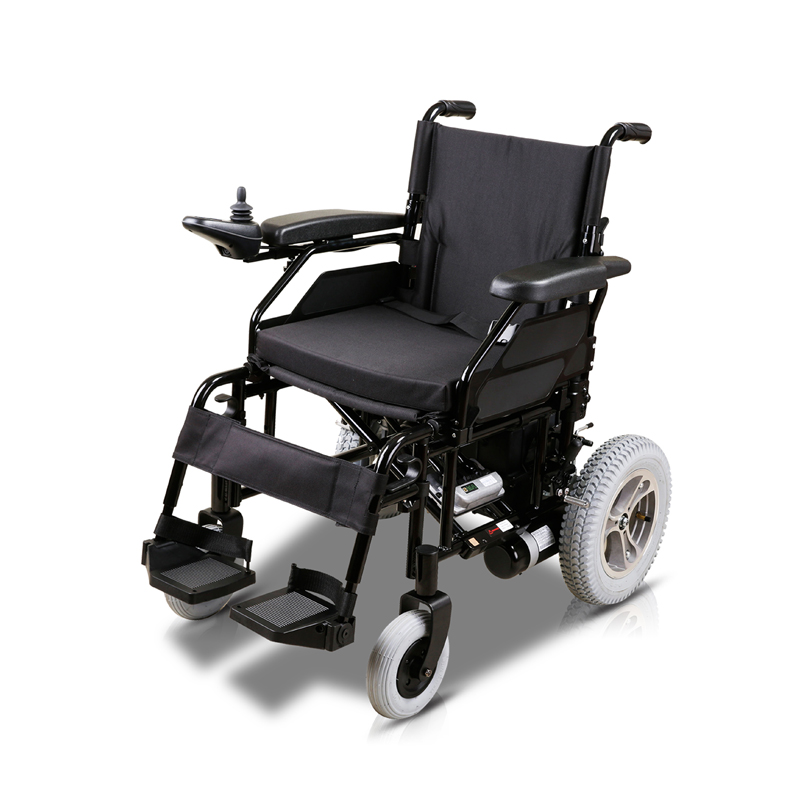
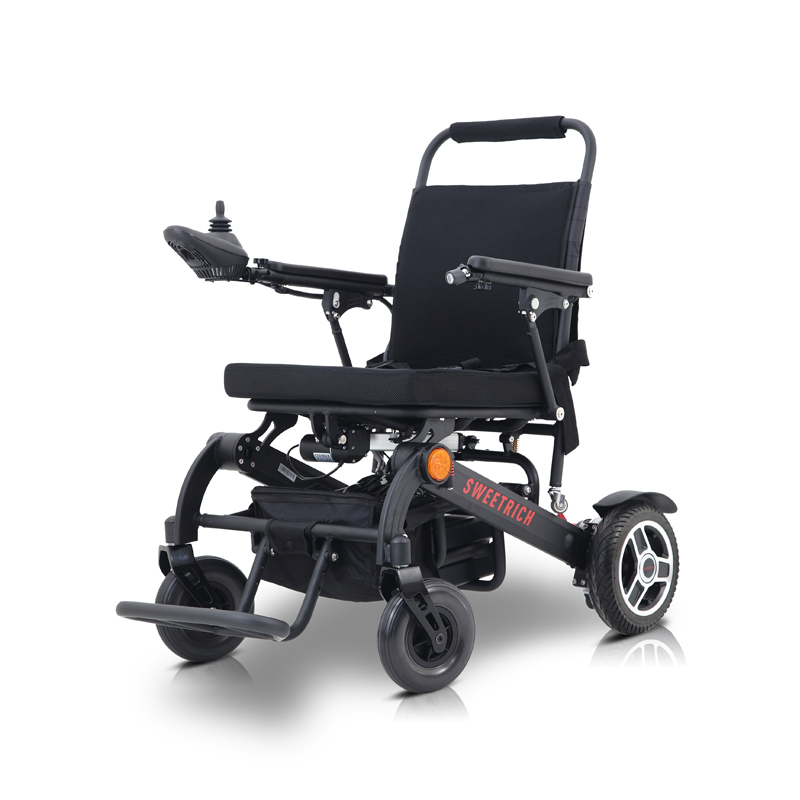
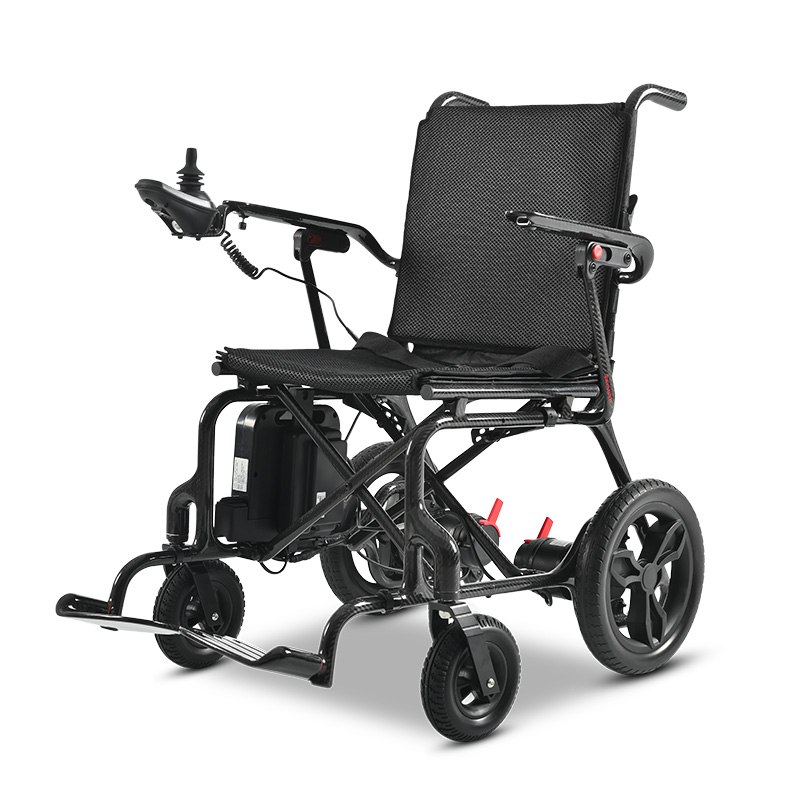
Choosing a power wheelchair is an important decision for users who need reliable mobility, comfortable seating, practical range, and enough stability for outdoor travel. A suitable wheelchair must do more than move from one location to another. It should provide a balanced combination of driving performance, safety, maneuverability, comfort, serviceability, and dependable construction. The iPower Sport FWD is designed as a front-wheel-drive electric wheelchair for users seeking a stronger outdoor-oriented platform than a lightweight indoor chair, while still benefiting from a folding-oriented design.
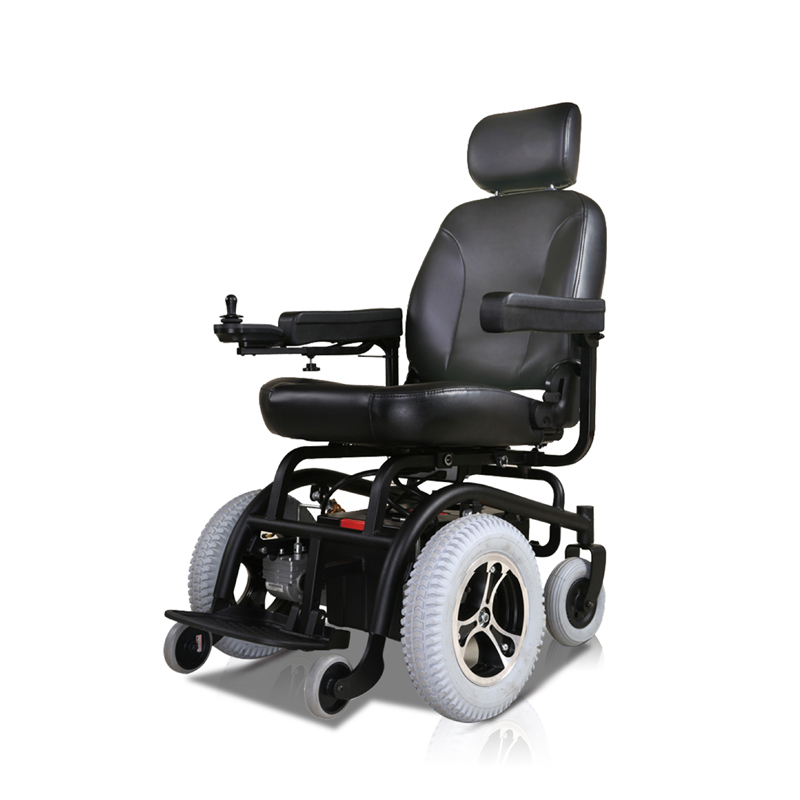
This model is categorized as a heavy-duty wheelchair and is equipped with large pneumatic tires, front suspension, anti-tip wheels, rear suspension, an adjustable seat back, electromagnetic braking, and twin 320-watt motors. Its lead-acid battery system is intended to support extended daily use, with a stated maximum driving range of approximately 30–40 kilometers under suitable conditions. With a maximum user weight capacity of 120 kilograms, the chair is positioned for users who require more substantial support than many compact travel wheelchairs can provide.
The wheelchair is also presented for outdoor use, making its combination of tire size, suspension, motor output, and forward-drive configuration especially relevant. It is not described as a medical device for the United States market, so buyers should evaluate it as a mobility product and confirm local requirements, intended use, transport arrangements, and applicable regulations before purchase.
iPower Sport FWD Certificated power suppier used battery electric wheelchair foldable for out door use
Designed for Practical Outdoor Mobility
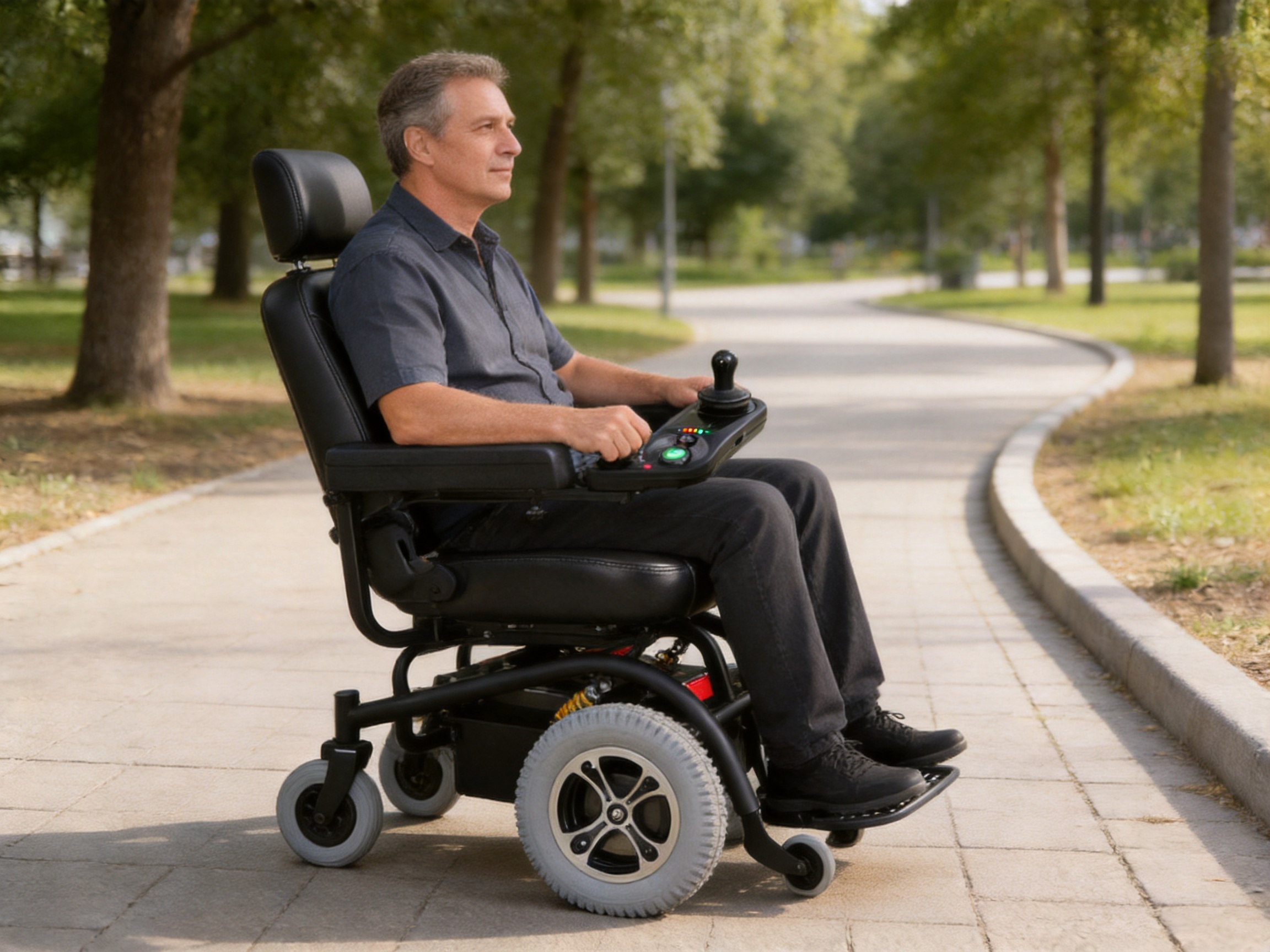
Many compact electric wheelchairs are optimized primarily for indoor floors, shopping centers, smooth pavements, and short trips. They may be easy to lift or store, but their smaller wheels and limited suspension can reduce comfort when users travel over uneven sidewalks, driveway transitions, compact gravel, or outdoor paths. The iPower Sport FWD takes a different approach by combining a relatively compact overall footprint with larger front tires and a suspension-equipped chassis.
The front tires measure 14 inches by 3 inches, while the rear tires measure 8 inches by 2.5 inches. The larger front wheels help the chair approach minor surface irregularities with greater confidence than a model using uniformly small caster wheels. They can also contribute to improved rolling comfort on outdoor surfaces. Pneumatic construction provides a degree of cushioning that can reduce the harshness of small bumps, although tire pressure must be checked regularly and puncture risks should be considered.
Front-wheel drive can be useful for outdoor maneuvering because the powered wheels are positioned toward the front of the chair. This layout can assist with climbing modest transitions and maintaining traction on certain surfaces. It also gives the chair a distinctive turning response. Users should practice in an open area before operating near traffic, crowded walkways, steep driveways, or obstacles, because front-wheel-drive chairs may handle corners differently from rear-wheel-drive or mid-wheel-drive models.
The stated maximum driving gradient is 10 degrees. This specification should not be interpreted as a recommendation to climb every slope at that angle. Actual performance depends on the user's weight, battery condition, tire pressure, surface texture, weather, obstacle shape, and the direction of travel. A safe operator should avoid unstable slopes, wet grass, loose gravel, abrupt edges, and cross-slope travel that could increase the risk of tipping.
Core Product Advantages
Large Pneumatic Tires for Outdoor Confidence
One of the clearest advantages of this power wheelchair is its tire configuration. The 14-inch front pneumatic tires are significantly more substantial than the small solid wheels commonly found on basic indoor power chairs. Their larger diameter helps the chair roll over small surface changes with less interruption. The 3-inch width also provides a broader contact area, which may contribute to stability on suitable paved and compact outdoor surfaces.
Pneumatic tires have both benefits and responsibilities. They generally offer a more forgiving ride than hard solid tires, especially when traveling over rough pavement. However, they require inflation checks and should be inspected for wear, cuts, or embedded objects. A maintenance routine that includes tire inspection can help preserve handling, range, and braking performance.
Suspension and Anti-Tip Protection
The wheelchair includes front suspension and rear suspension features, along with anti-tip wheels. Suspension helps isolate the seating area from some of the vibration generated by uneven terrain. This is important for users who spend extended periods in the chair or who are sensitive to repeated jolts. Suspension does not eliminate the need for careful driving, but it can improve the overall experience on appropriate outdoor surfaces.
Anti-tip wheels provide an additional layer of stability when the chair accelerates, climbs a transition, or encounters a change in surface level. They are not a replacement for safe operating technique. Users should still approach ramps and obstacles slowly, keep the chair within its recommended limits, and avoid modifications that alter the balance of the chassis.
Comfort-Oriented Seating
The product features a leather-like cushion seat and an adjustable seat back. These features support a more adaptable seating position for different users and daily activities. A supportive seat can help reduce fatigue during shopping, outdoor recreation, transportation, or extended visits. The adjustable backrest also allows the user or caregiver to select a more upright or relaxed position, subject to safe operating requirements.
Comfort depends on more than the cushion material. Seat width, posture, foot positioning, arm support, clothing, temperature, and the duration of use all matter. Buyers should confirm the complete seating dimensions and adjustability range before ordering, particularly when the chair is being purchased for a specific user.
Electromagnetic Braking
The electromagnetic brake system is designed to help bring the chair to a controlled stop when the drive controls are released. This type of braking is commonly used in powered mobility products because it can help prevent unintended rolling when the motor is not being commanded to move. Brake performance may vary depending on slope, surface condition, battery status, and mechanical condition.
Users should test the brake response in a safe, level area before regular use. The chair should not be operated if it rolls unexpectedly, stops unevenly, or behaves differently from normal. Regular inspection and qualified service are especially important for a heavy-duty outdoor model, where braking components may experience more demanding conditions.
Twin Motors for Balanced Drive Performance
The iPower Sport FWD uses two 24-volt, 320-watt motors. Twin motors distribute propulsion across the powered wheels and can provide consistent drive performance when the chair is carrying the user over suitable terrain. The listed motors are supplied from Taiwan, while the motor controller is identified as a 24-volt, 50-amp PG unit from the United Kingdom.
The combination of dual motors and a dedicated controller supports smooth acceleration and responsive control when correctly calibrated. It also allows the drive system to be matched to the chair's intended weight capacity and outdoor positioning. As with all electric wheelchairs, performance is influenced by battery condition, ambient temperature, tire pressure, load, slope, and driving style.
Specifications at a Glance
| Product category | Heavy-duty electric wheelchair |
| Drive configuration | Front-wheel drive |
| Overall dimensions | 980 mm long × 600 mm wide × 1180 mm high |
| Maximum forward speed | 8 km/h, approximately 5 miles per hour |
| Maximum stated gradient | 10 degrees |
| Maximum stated range | 30–40 km, approximately 19–25 miles |
| Weight capacity | 120 kg, approximately 265 lb |
| Suspension | Front suspension with rear suspension features listed |
| Front tires | 14 inches × 3 inches, pneumatic |
| Rear tires | 8 inches × 2.5 inches |
| Brake system | Electromagnetic brake |
| Batteries | Two 12-volt, 40-ampere-hour lead-acid batteries |
| Charger | DC 24 volts, 5 amps; AC input 115–230 volts |
| Charging time | Approximately 6–8 hours |
| Motors | Two 24-volt, 320-watt motors |
| Motor controller | 24-volt, 50-amp controller |
The dimensions provide a useful starting point for evaluating storage and access. At approximately 600 millimeters wide, the chair may be suitable for many residential and commercial passageways, but users should measure doorways, elevator entrances, ramps, and vehicle loading areas. The 980-millimeter length and 1180-millimeter height should also be considered when planning storage.
The product information lists the heaviest part as 56 kilograms and also includes a parenthetical value of 35 pounds. These figures are not equivalent; 56 kilograms is approximately 123 pounds. Buyers and transport providers should request confirmation of the actual heaviest component, the folded dimensions, and the lifting points before arranging transportation. This is especially important for caregivers who expect to load the chair into a vehicle manually.
Battery System and Driving Range
The wheelchair uses two 12-volt, 40-ampere-hour lead-acid batteries connected to provide a 24-volt system. Lead-acid batteries remain widely used in mobility products because they are familiar, relatively accessible, and compatible with established charging and service practices. They can provide dependable operation when properly charged, maintained, and replaced at the appropriate interval.
The stated range is 30–40 kilometers, or approximately 19–25 miles. This figure should be treated as a maximum reference rather than a guaranteed distance for every trip. Range testing is usually performed under controlled conditions. Real-world range can be reduced by heavier loads, frequent starts and stops, steep slopes, low temperatures, soft surfaces, underinflated tires, battery age, and prolonged use at maximum speed.
For the best battery life, the chair should be charged according to the supplied charger instructions. The listed charger accepts an AC input of 115–230 volts and provides a DC output of 24 volts at 5 amps. Users should use the approved charger, keep charging connections dry, and avoid covering the charger during operation if ventilation is required. Batteries should be stored and handled in accordance with the manufacturer's safety instructions.
Lead-acid batteries are heavier than many modern lithium battery systems. That additional weight can contribute to overall chair mass and transport difficulty. On the other hand, the established battery format may be attractive to buyers who prioritize familiar replacement practices and a lower initial system complexity. Customers comparing this chair with lithium-powered competitors should evaluate total ownership cost, expected travel frequency, replacement availability, transport requirements, and local service support.
Practical Range Planning
A responsible range plan should include a reserve. If a user expects to travel 15 miles, relying on the highest advertised range would leave little margin for weather, hills, traffic delays, or an unexpected detour. It is better to recharge after regular use and plan routes with accessible charging options where possible.
Battery performance can also be affected by storage conditions. Long periods of disuse may reduce battery condition if the batteries are not maintained correctly. A regular inspection routine should include checking the charger indicator, examining cables for damage, and monitoring whether the chair's performance changes noticeably from one trip to another.
Portability, Folding, and Storage Considerations
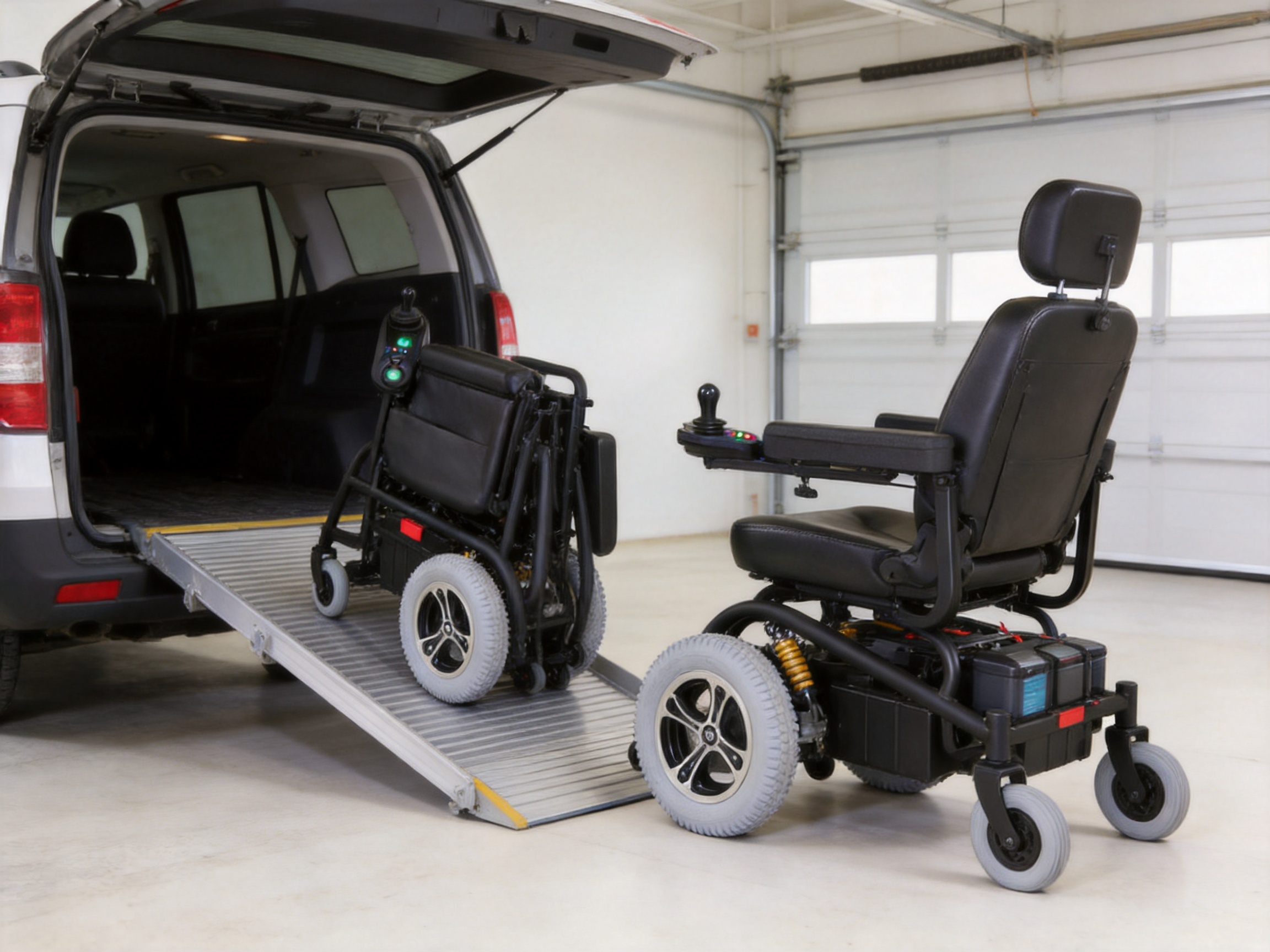
The product title identifies the wheelchair as foldable, indicating that portability is an important part of its market positioning. Folding designs can make storage more convenient and may help users organize a home, office, or travel vehicle. However, the practical benefits depend on the actual folding mechanism, folded dimensions, component weight, and whether the batteries must be removed before transport.
Because the chair includes large tires, suspension, twin motors, and lead-acid batteries, it should not be assumed to have the same lifting convenience as an ultra-light travel wheelchair. The listed heaviest-part information should be verified directly before purchase. Buyers should ask whether the chair folds manually, whether the seat back or footrests fold independently, and whether special equipment is recommended for loading.
Storage space should be measured in advance. The user should allow room for turning the chair into position, accessing the charging port, and removing or inspecting the batteries if required. The storage location should be dry, protected from extreme temperatures, and free of obstacles that could interfere with folding or unfolding.
How It Compares with Common Competitor Categories
Compared with Basic Indoor Electric Wheelchairs
Basic indoor chairs often prioritize compactness, low weight, and a small turning area. They may perform well on smooth floors but have limited capability on uneven pavement or outdoor paths. The iPower Sport FWD offers a more outdoor-focused package through its larger front tires, suspension, anti-tip wheels, stronger chassis positioning, and higher stated range.
The trade-off is that a more robust outdoor platform may be heavier and less convenient to lift. Buyers who mainly travel inside a small apartment may not need this level of outdoor equipment. In contrast, users who regularly cross sidewalks, driveways, public paths, or hard-packed surfaces may value the increased rolling comfort and stability.
Compared with Lightweight Lithium Travel Chairs
Lightweight lithium-powered chairs are frequently selected for air travel, car transport, and quick storage. Their advantages commonly include reduced lifting weight, compact folding, and a modern battery format. The iPower Sport FWD competes in a different area by emphasizing outdoor handling, larger tires, suspension, dual-motor power, and a 120-kilogram capacity.
For a user who needs to lift a chair into a small car every day, a lightweight model may be more appropriate. For a user who values outdoor ride quality and stronger terrain capability, the iPower Sport FWD may offer a better balance. The right choice depends on whether portability or outdoor performance is the primary requirement.
Compared with Rear-Wheel-Drive Models
Rear-wheel-drive chairs can provide a familiar steering response and may be preferred by users who are accustomed to traditional mobility scooters or rear-powered systems. A front-wheel-drive chair such as this model places the powered wheels at the front and uses larger front tires to engage the terrain. This can be advantageous when approaching some surface transitions, although it requires the user to become familiar with turning behavior.
No drive configuration is ideal for every environment. Demonstration driving, when available, is valuable. Users should test forward motion, reversing, tight turns, ramp entry, and stopping before relying on the chair outdoors.
Compared with Mid-Wheel-Drive Chairs
Mid-wheel-drive wheelchairs are often designed to provide a tight turning circle around the user's central seating position. This can be beneficial in compact indoor spaces. The iPower Sport FWD instead emphasizes front-wheel traction and larger front tires. It may be especially attractive to buyers who prioritize outdoor travel and a stable approach to minor terrain changes over the smallest possible turning radius.
Manufacturing Strengths and Product Development Capabilities
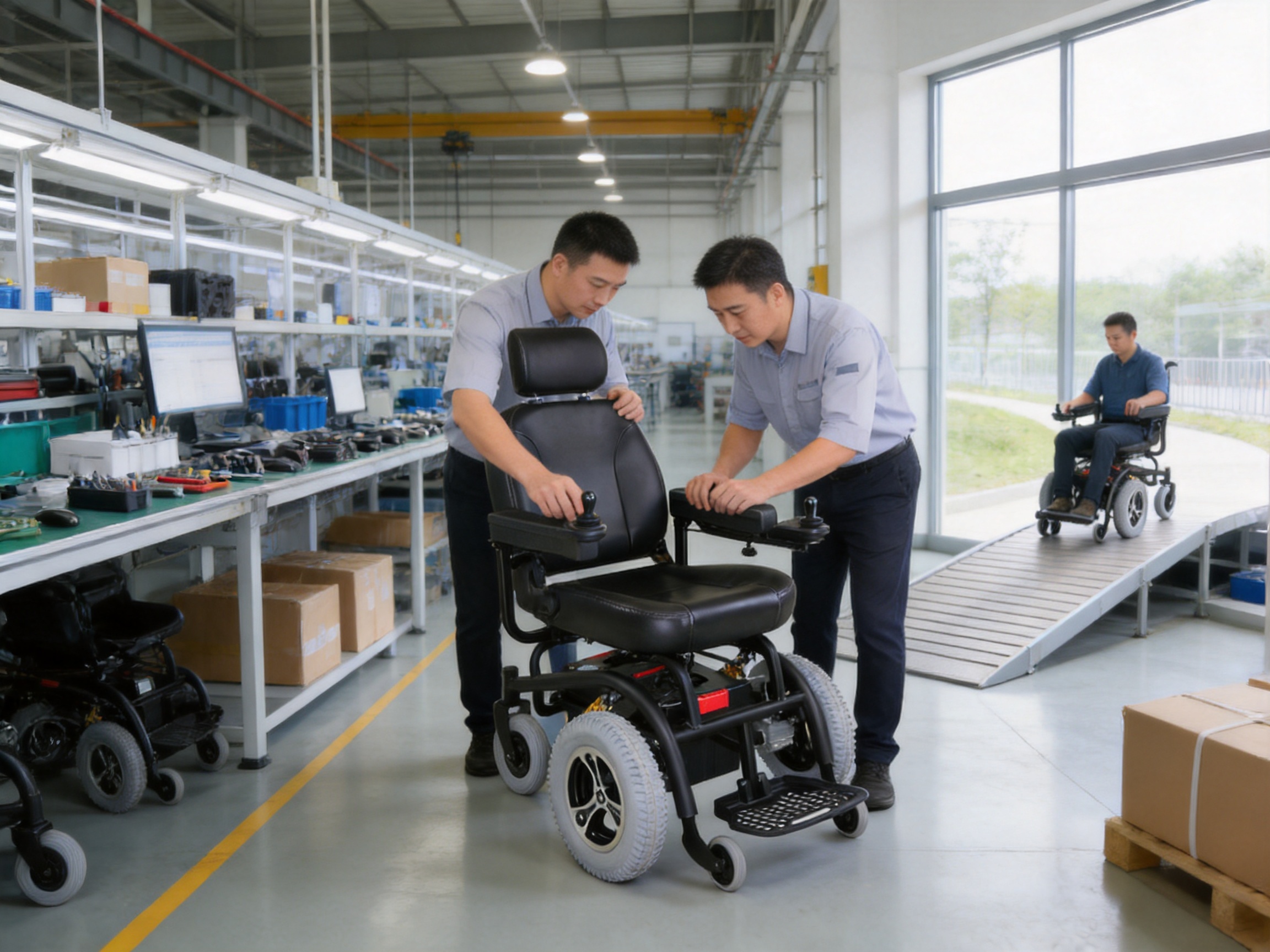
Suzhou Sweetrich Vehicle Industry Technology Co., Ltd. was established in 2011 and operates from Suzhou Industrial Zone in Jiangsu, China. The company reports a 60-acre site and a 30,000-square-meter factory. Its activities include the research, development, and production of mobility scooters and power wheelchairs.
A manufacturing base of this scale can support more than final assembly. It may allow engineering, purchasing, production management, quality inspection, warehousing, and export coordination to operate within an integrated industrial structure. For mobility products, this integration is valuable because performance depends on the interaction of mechanical frames, electrical controls, batteries, seating systems, wheels, braking components, and finish quality.
The company states that it owns intellectual property rights for its electric scooters and power wheelchairs. In practical terms, internal product development capability can help a manufacturer refine chassis geometry, seating arrangements, control systems, drive performance, and folding structures rather than relying solely on generic components. It can also make product updates easier when market requirements or user feedback identify opportunities for improvement.
The company describes its approach as combining scientific product design, advanced control technology, and driving systems intended to support smooth and safe operation. These capabilities are reflected in the product's use of a dedicated motor controller, electromagnetic braking, dual motors, suspension, and anti-tip features. The quality of any individual unit still depends on production consistency, inspection standards, component traceability, and final testing.
Process Control and Assembly Consistency
Power wheelchairs require careful assembly because small deviations can affect steering, braking, alignment, vibration, and battery performance. A structured manufacturing process should include incoming inspection of key components, controlled frame assembly, secure electrical connections, correct wheel alignment, brake verification, battery installation checks, and final operational testing.
For a model with pneumatic tires and suspension, inspection should also address tire seating, inflation, suspension attachment points, fastener security, and anti-tip wheel alignment. Electrical testing should confirm charger compatibility, controller response, motor rotation, wiring integrity, and emergency stopping behavior. These steps help reduce the likelihood that a chair leaves the factory with a problem that could have been identified before shipment.
Research and Development Orientation
The mobility market serves users with different body sizes, living environments, travel habits, and accessibility challenges. A manufacturer with ongoing research and development can respond to these differences through product families rather than a single universal design. Outdoor chairs may emphasize tires and suspension, while travel models may focus on folding and reduced weight.
The iPower Sport FWD reflects an effort to combine several priorities in one platform: outdoor drive capability, seating comfort, practical dimensions, battery range, and folding-oriented storage. Combining these features requires engineering compromises. Larger tires and lead-acid batteries improve certain performance characteristics but add weight. A compact width assists access but must be balanced against seating stability. A powerful drive system must be matched to safe braking and reliable controller programming.
International Market Experience
The company reports exporting its products to America, Europe, Japan, Australia, the Middle East, Russia, and other markets. International distribution requires attention to different voltage environments, labeling practices, packaging requirements, service expectations, and customer preferences. The supplied charger specification of 115–230 volts is relevant to regions with different AC standards, although buyers should confirm the plug type, local approval requirements, and exact configuration before ordering.
International experience can also strengthen a supplier's understanding of logistics and after-sales communication. For distributors, this may simplify private-label programs, product documentation, spare-parts planning, and bulk purchasing. For individual users, the most important questions remain practical: What support is available in the destination country? Which replacement parts are stocked locally? How are warranty claims handled? What technical documents accompany the product?
Safety and Responsible Use
The chair should be operated only by a user who can understand the controls or by a trained caregiver. Before the first trip, the operator should learn how to accelerate, stop, reverse, turn, use the electromagnetic brake, and respond if the chair loses power. Practice should begin on a level, open surface away from vehicles and pedestrians.
Users should observe the stated 120-kilogram weight capacity. This limit includes the user and any carried items unless the manufacturer specifies otherwise. Exceeding the capacity can affect stability, braking distance, motor temperature, battery range, and structural durability.
Slopes require special caution. Even though a maximum gradient of 10 degrees is listed, operators should use gentler routes whenever possible. The chair should approach ramps straight on, avoid sudden steering movements, and never travel across a slope if the surface creates a significant tipping risk. Loose gravel, mud, wet grass, ice, and uneven edges can reduce traction.
Water exposure should be minimized. The wheelchair should not be driven through deep puddles or exposed to heavy rain without appropriate protection. Water can affect electrical connectors, the controller, batteries, braking components, and seat materials. After outdoor use in damp conditions, the chair should be dried and inspected before charging.
The chair should not be used as a passenger seat in a motor vehicle unless it has been specifically tested, labeled, and approved for occupied transportation. In most cases, users should transfer to an approved vehicle seat and secure the wheelchair separately according to transport instructions.
Maintenance Recommendations
Tires and Wheels
Check pneumatic tire pressure regularly and maintain it within the manufacturer's recommended range. Underinflated tires can increase rolling resistance, reduce range, and affect steering. Overinflated tires may reduce comfort and alter traction. Inspect the tread and sidewalls for cracks, cuts, or unusual wear.
Batteries and Charging
Inspect battery cables and terminals for looseness, corrosion, or damage. Charge the batteries in a dry, ventilated location using the specified charger. Do not use a charger with an incompatible voltage or connector. If the charging time changes substantially or the travel range decreases quickly, seek qualified service.
Frame, Suspension, and Fasteners
Regularly examine the frame, seat mount, armrests, foot supports, suspension components, anti-tip wheels, and folding joints. Fasteners should remain secure, but users should not overtighten or modify structural components without technical guidance. Any unusual noise, excessive movement, cracking, or change in steering should be investigated before further use.
Cleaning and Upholstery
Clean the leather-like seat surface with a suitable mild cleaner and a soft cloth. Avoid abrasive products that could damage the finish. Keep control panels and electrical connectors dry. Dirt accumulated around wheels and suspension components should be removed carefully so it does not interfere with movement.
Who May Benefit Most from This Model?
The iPower Sport FWD may suit users who need a powered mobility solution for a mixture of indoor and outdoor activities and who place a higher value on outdoor comfort than on minimum lifting weight. It may be appropriate for users who travel around residential neighborhoods, shopping areas, paved parks, accessible public facilities, and other environments with reasonably maintained surfaces.
Its 120-kilogram capacity may also make it relevant to users who find lightweight travel chairs too limited. The adjustable seat back, cushion seat, suspension, and larger tires can support longer periods of use. Caregivers may appreciate the anti-tip features and electromagnetic braking, while distributors may value the combination of recognizable components and a manufacturer with export experience.
It may be less suitable for users who need an ultra-light chair for frequent air travel, who must lift the chair into a compact vehicle without assistance, or who regularly encounter very rough terrain, deep mud, steep slopes, or stairs. In these cases, the buyer should compare specialized products designed for those circumstances.
Purchasing and Verification Checklist
Before purchasing, confirm the exact model configuration and whether the supplied unit includes the features listed in the product specification. Ask for the folded length, folded width, folded height, total weight, and the weight of the heaviest removable part. The published heaviest-part data contains an inconsistency between kilograms and pounds, so this point should be clarified in writing.
Confirm the battery type, battery dimensions, replacement availability, charging connector, plug format, warranty coverage, and expected service life. Buyers in different countries should verify whether the charger is supplied with the correct local plug and whether additional local compliance documentation is required.
Check the seating dimensions and the usable width of the chair. Measure the user's doorways, elevator, ramps, storage location, and vehicle loading area. If the chair will be transported frequently, determine whether a ramp, lift, hoist, or second person is required.
Distributors should also request spare-parts information for tires, tubes, batteries, chargers, controllers, motors, armrests, seat components, and brake-related parts. A supplier that can provide clear technical documents and consistent replacement support can reduce downtime over the product's service life.
Q&A
Is this power wheelchair intended for outdoor use?
Yes. Its large front pneumatic tires, suspension features, anti-tip wheels, front-wheel-drive layout, and stated 30–40-kilometer maximum range make it oriented toward outdoor mobility as well as suitable indoor environments. It should still be used only on surfaces and slopes appropriate for the chair and operator.
What is the maximum user weight?
The stated weight capacity is 120 kilograms, or approximately 265 pounds. The capacity should include the user and any carried belongings unless the manufacturer provides a different instruction.
How fast can it travel?
The listed maximum forward speed is 8 kilometers per hour, approximately 5 miles per hour. Actual speed can vary according to battery charge, user weight, terrain, controller settings, and safety conditions.
How far can it travel on one charge?
The stated maximum driving range is 30–40 kilometers, or approximately 19–25 miles. Actual range is affected by slope, surface, temperature, tire pressure, battery age, load, speed, and stopping frequency. Users should plan trips with a reserve.
What type of batteries does it use?
It uses two 12-volt, 40-ampere-hour lead-acid batteries in a 24-volt system. Lead-acid batteries are familiar and widely serviceable, but they are heavier than many lithium alternatives.
How long does charging take?
The listed charging time is approximately 6–8 hours. Charging should be performed with the specified 24-volt, 5-amp charger and according to the supplied safety instructions.
Does it have a safety brake?
The chair is equipped with an electromagnetic brake system. The operator should test the brake on a level surface before use and arrange service if the chair rolls unexpectedly or stops abnormally.
Is the wheelchair foldable?
The product title identifies it as foldable. However, the exact folded dimensions, folding sequence, and battery-removal requirements should be confirmed with the supplier before purchase, especially because the chair uses substantial tires, suspension, motors, and lead-acid batteries.
Can it fit through standard doors?
The listed overall width is approximately 600 millimeters. Many doorways may accommodate this width, but users should measure their own doors, thresholds, elevators, and turning spaces rather than relying on a general assumption.
Is it a medical device in the United States?
The supplied product information describes it as a non-medical device for the United States market. Buyers should consult the supplier and applicable local authorities for current classification, labeling, use, and compliance requirements.
What makes it different from a lightweight travel wheelchair?
Its main differences are the outdoor-oriented chassis, large pneumatic front tires, suspension, dual 320-watt motors, anti-tip wheels, electromagnetic braking, and higher stated weight capacity. A lightweight travel chair may be easier to lift, so the best choice depends on whether outdoor capability or minimum transport weight is more important.
What manufacturing strengths support the product?
The manufacturer reports a dedicated mobility-product factory, more than a decade of industry experience, research and development capability, intellectual property ownership, structured production management, and exports to multiple international markets. Buyers should still request current quality, warranty, and compliance documentation for the specific order.
Conclusion
The iPower Sport FWD is a substantial outdoor-oriented power wheelchair that combines front-wheel drive, large pneumatic tires, suspension, anti-tip wheels, twin motors, electromagnetic braking, a supportive seat, and a stated 30–40-kilometer range. These features give it a meaningful advantage over basic indoor chairs and some lightweight travel models when ride comfort, traction, and daily outdoor performance are the primary priorities.
Its lead-acid battery system and heavy-duty construction may make it less convenient to lift than an ultra-light lithium wheelchair, but they support a familiar and serviceable platform for users who need a stronger mobility solution. The folding-oriented design can improve storage convenience, although the actual folded dimensions and heaviest-part weight should be verified before purchase.
The manufacturer's reported factory resources, product development experience, international market presence, and focus on mobility technology provide a solid foundation for production and distribution. For the buyer, the most important next steps are to confirm the exact configuration, verify transport details, review safety and warranty documentation, and match the chair's capabilities to the user's environment. When selected and maintained responsibly, this model can provide a practical balance between outdoor confidence, seating comfort, driving range, and everyday independence.
References
1. Product specification sheet for the iPower Sport FWD front-wheel-drive electric wheelchair.
2. Manufacturer-provided information concerning mobility scooter and power wheelchair design, production, and export operations.
3. General principles of powered wheelchair operation, battery care, tire maintenance, and slope safety.
4. General guidance for evaluating wheelchair dimensions, weight capacity, braking systems, suspension, and transport requirements.