 info@sweetrich.cn
  +86-(0)512-82283871
Content
- 1 Product Overview
- 2 Designed for Practical Travel
- 3 Stability and Maneuverability
- 4 Suspension and Riding Comfort
- 5 Motor, Battery, and Charging System
- 6 Electromagnetic Braking
- 7 Weight Capacity and Everyday Use
- 8 Comparison with Larger and Three-Wheel Alternatives
- 9 Manufacturing Experience and Product Development
- 10 Production Management and Quality Focus
- 11 Design Strengths for Distributors and Fleet Buyers
- 12 Maintenance and Service Considerations
- 13 Safe Operation Guidelines
- 14 How to Evaluate the Scooter Before Purchase
- 15 Frequently Asked Questions
- 15.1 What type of product is the SW1000L?
- 15.2 What is the maximum speed?
- 15.3 What is the stated driving range?
- 15.4 How much weight can the scooter support?
- 15.5 Does the scooter have four wheels?
- 15.6 Does it include suspension?
- 15.7 What kind of brake does it use?
- 15.8 What motor does the scooter use?
- 15.9 What batteries are available?
- 15.10 How long does charging take?
- 15.11 What charger is supplied?
- 15.12 Can the scooter climb hills?
- 15.13 Is this scooter a medical device?
- 15.14 Who manufactures the scooter?
- 15.15 What manufacturing experience does the company have?
- 15.16 Is the product suitable for distributors?
- 16 Conclusion
- 17 References
- 18 Product: SW1000L Ready to ship mobility scooter 9 inch 4 wheels scooters

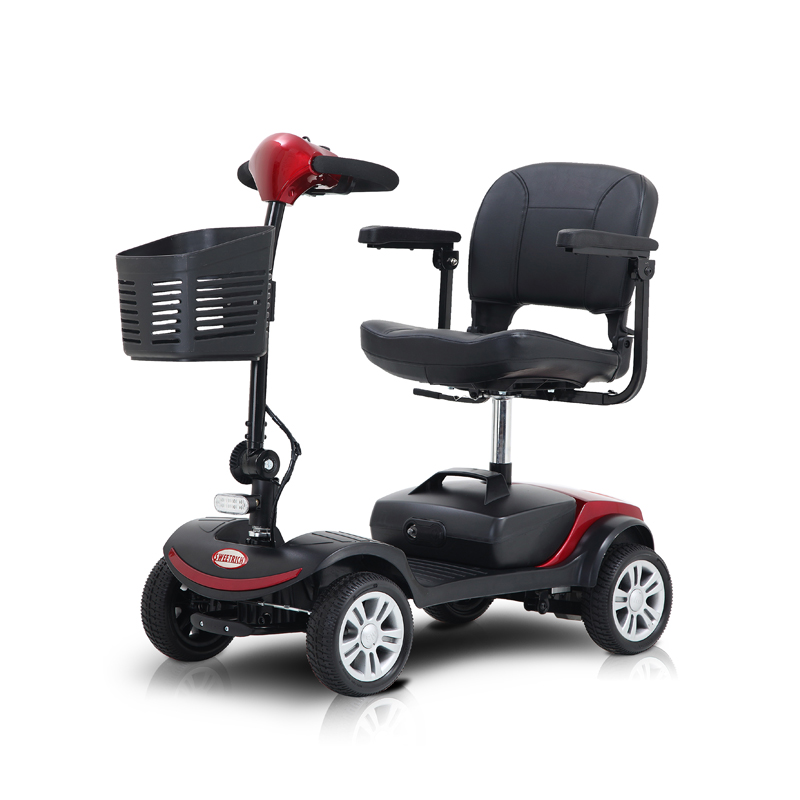
Choosing a mobility scooter involves more than comparing appearance or advertised speed. A practical scooter must balance portability, stability, operating range, comfort, braking performance, ease of charging, and dependable manufacturing. The SW1000L Ready to Ship Mobility Scooter is designed around these everyday requirements. It is a compact four-wheel travel scooter with a top speed of 8 km/h, a stated driving range of approximately 15–25 km, a maximum user weight capacity of 136 kg, and a 24 V, 300 W motor.
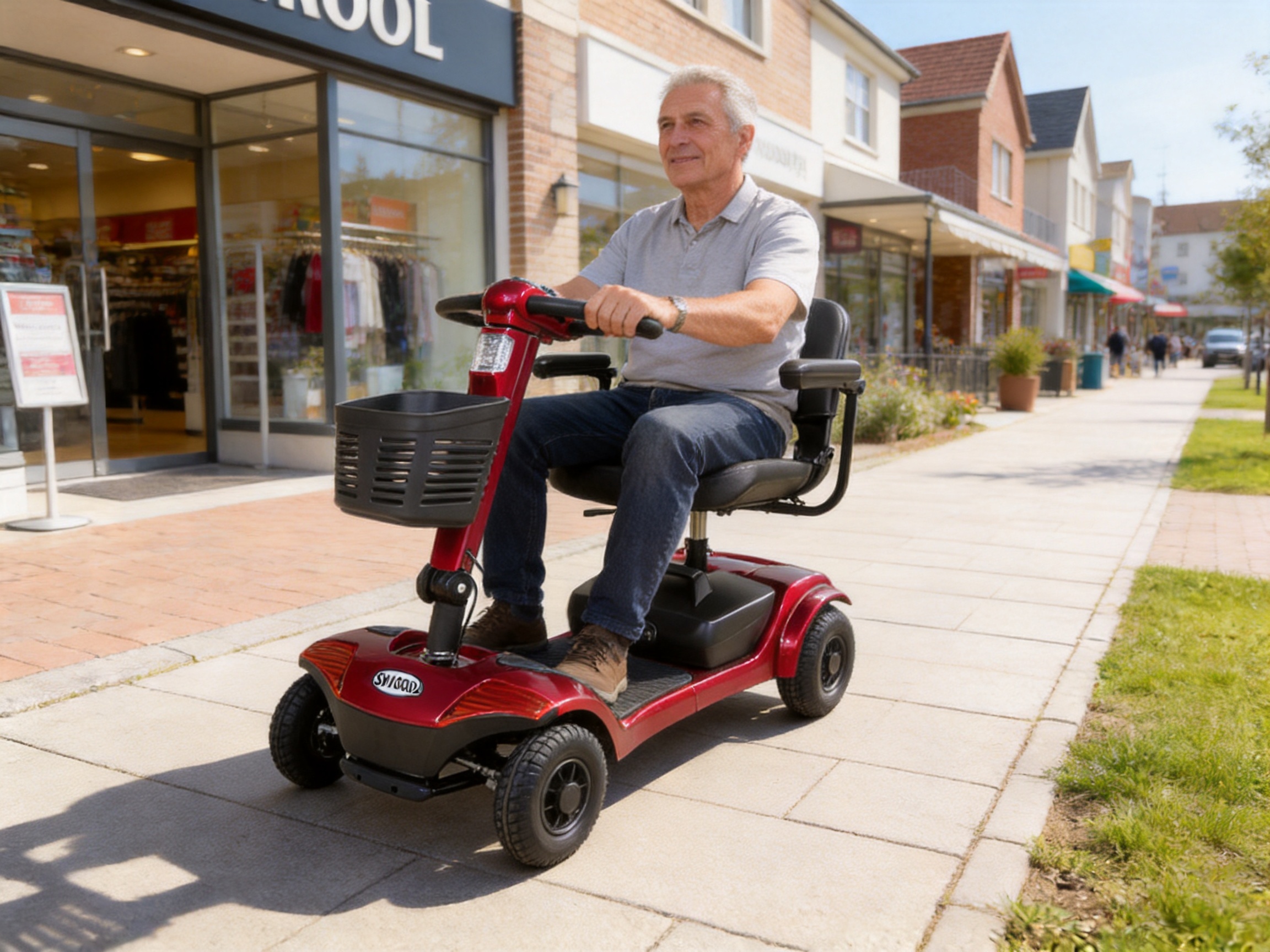
The scooter belongs to the Travel Smart Scooters category and is intended to support convenient personal transportation. Its compact body, relatively narrow width, rear suspension, electromagnetic braking system, and four-wheel layout make it suitable for users who want a straightforward mobility solution for routine trips. Typical applications may include movement around residential areas, shopping environments, indoor facilities, paved paths, and other appropriate private or public spaces where local regulations permit its use.
The product information identifies this model as a non-medical device for the United States market. It should therefore be considered a mobility and transportation product rather than a medical treatment device. Users should follow the operating instructions, observe local laws, and consult qualified professionals when they need advice about individual mobility, posture, or safe operation.
Product Overview
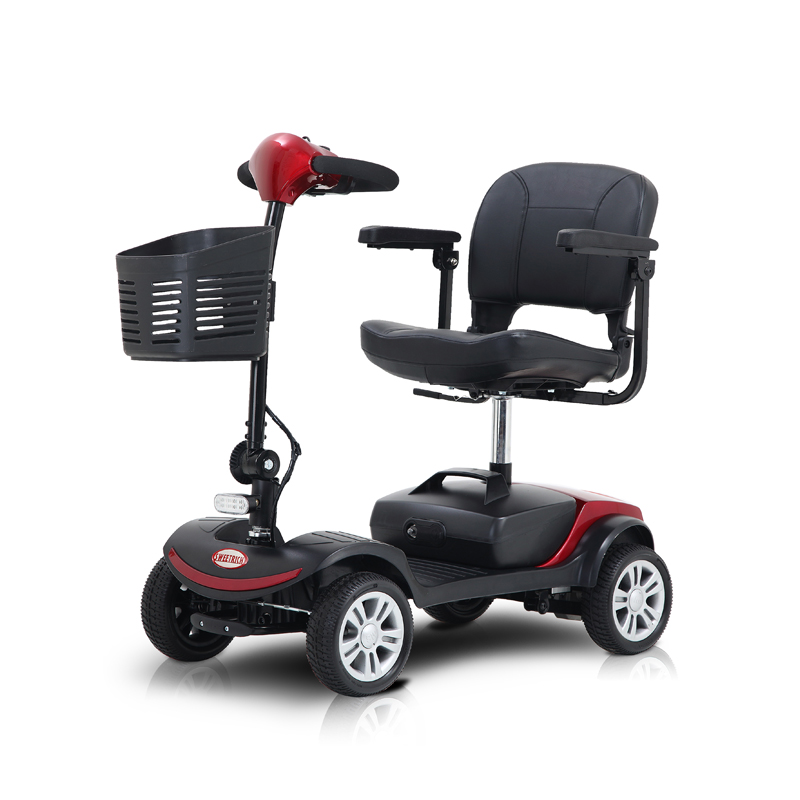
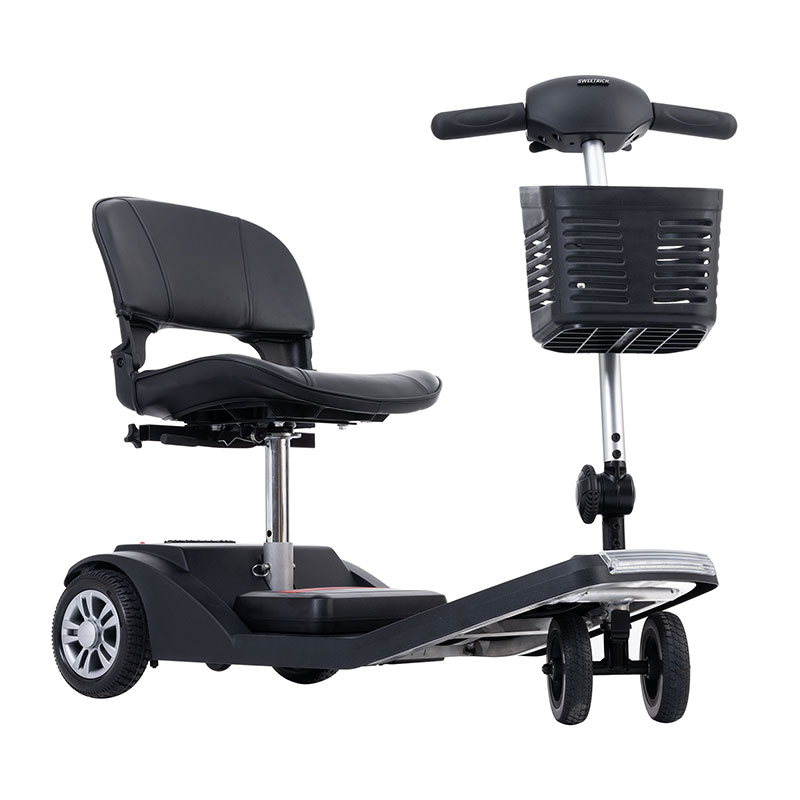
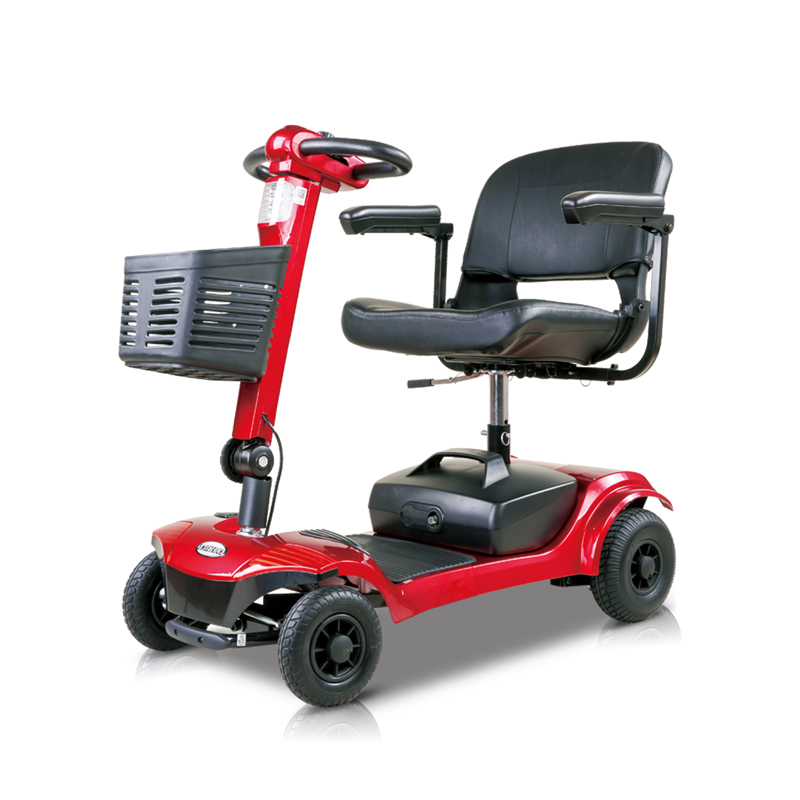
The SW1000L is built as a four-wheel electric mobility scooter with a practical travel-oriented configuration. Its dimensions are approximately 1,110 mm long, 525 mm wide, and 920 mm high. A width of 525 mm gives the scooter a comparatively compact footprint for a four-wheel design. This can be valuable when navigating through many doorways, around furniture, along corridors, or in other locations where a larger scooter may be difficult to position.
The model uses two front tires measuring 8 inches by 2.5 inches and two rear tires measuring 9 inches by 3 inches. The larger rear tires contribute to a balanced road contact arrangement and help create a stable visual and mechanical platform. The four-wheel configuration can offer greater low-speed stability than a three-wheel layout, particularly for users who prioritize a planted feel during turns and routine maneuvering.
Power is supplied by a 24 V, 300 W motor. This rating is suited to a compact travel scooter designed for moderate daily use rather than high-speed road transportation. The maximum forward speed is 8 km/h, equivalent to approximately 5 miles per hour. This speed is appropriate for controlled travel in many low-speed environments, although users must always reduce speed when turning, operating near pedestrians, crossing uneven areas, or traveling in unfamiliar surroundings.
The stated maximum driving gradient is 10 degrees. This figure should not be interpreted as a guarantee that every user, surface, or battery condition will produce the same climbing performance. Incline capability can be affected by user weight, tire condition, battery charge, surface texture, weather, temperature, and the length of the slope. Slopes should be approached cautiously, and users should avoid terrain that exceeds the scooter’s rated capability.
The stated driving range is 15–25 km, or approximately 9.5–15.5 miles. As with most electric mobility products, the actual range depends on many variables. Battery condition, total load, temperature, tire pressure, gradient, frequent starting and stopping, surface quality, and driving habits can all affect the distance available between charges. The lower end of the stated range may be a more appropriate planning reference for demanding conditions.
SW1000L Ready to ship mobility scooter 9 inch 4 wheels scooters
Designed for Practical Travel
One of the strongest aspects of the SW1000L is its focus on practical travel rather than unnecessary complexity. Many mobility scooters are built with large frames, extensive accessories, or high-output systems that can increase size and weight. These designs may be useful for specific applications, but they can be inconvenient for users who need a more manageable scooter for ordinary trips.
The SW1000L takes a compact approach. Its 525 mm width can assist with maneuvering in restricted spaces, while its 1,110 mm length provides a useful balance between stability and transport-friendly proportions. The design is intended to serve users who want the benefits of a four-wheel scooter without moving immediately into a large, heavy-duty platform.
This compact format may provide several practical advantages:
First, the scooter can be easier to position in a home environment. A smaller footprint may make it more convenient to store in a designated area, turn in a hallway, or approach a table, counter, or chair.
Second, the scooter can be suitable for routine local journeys. The 8 km/h maximum speed gives users a controlled pace for many low-speed travel situations, while the stated 15–25 km range can support a variety of short and medium-distance outings when the battery is properly maintained.
Third, the four-wheel structure adds a stable base for users who prefer more predictable support during straight-line travel and gentle turns. A three-wheel scooter may offer a tighter turning circle in some circumstances, but a four-wheel design is often selected by buyers who place a higher priority on overall stability and balanced handling.
Fourth, the 300 W motor and 24 V electrical system provide a relatively simple power architecture. A straightforward configuration can make the product easier to understand for distributors, service technicians, caregivers, and end users. It also allows the scooter to remain focused on its intended travel role rather than attempting to serve as a high-performance outdoor vehicle.
Stability and Maneuverability
Stability is a key consideration in a mobility scooter. The SW1000L uses four wheels, with the front and rear tires sized to support a balanced travel platform. Four points of contact can help the scooter feel more settled during normal operation, especially when traveling at moderate speed on suitable, reasonably level surfaces.
The 8-inch front tires and 9-inch rear tires are proportioned for a compact scooter. The 2.5-inch front tire width and 3-inch rear tire width provide a practical contact area without making the overall body excessively wide. The result is a design that aims to combine manageable dimensions with a reassuring four-wheel stance.
Handling also depends on the scooter’s control system. The product specification lists a 24 V/50 A dynamic motor controller. The controller regulates electrical power delivered to the motor and forms part of the system that determines acceleration response, speed control, and general driving behavior. A properly configured controller can contribute to smooth operation when the user starts, stops, or adjusts speed.
Users should understand that stability is not determined by wheel count alone. Safe operation requires an appropriate speed, correct posture, proper weight distribution, and attention to surface conditions. Sharp turns, cross slopes, loose gravel, wet surfaces, curbs, and sudden changes in elevation can affect handling. The scooter should be used within its design limits and according to the supplied operating guidance.
The maximum gradient specification of 10 degrees is useful when evaluating the scooter’s intended capability. It indicates that the product is designed to manage moderate inclines under suitable conditions. However, a slope should be assessed before entering it. A long incline may place greater demand on the motor and battery than a short incline of the same angle. When descending, users should maintain controlled speed and avoid abrupt steering movements.
Suspension and Riding Comfort
The SW1000L is specified with rear suspension. Suspension can improve the riding experience by helping the rear section respond to minor irregularities in an appropriate travel surface. It may reduce the harshness associated with small bumps and provide a more composed feel during ordinary movement.
Rear suspension is particularly relevant for a compact scooter because the rear wheels carry a significant part of the overall load. By incorporating suspension into the rear section, the design acknowledges that comfort and control are important even in a smaller travel-oriented model.
Suspension does not make the scooter suitable for every type of terrain. The product remains a compact mobility scooter, not an off-road vehicle. Users should avoid deep potholes, soft ground, steep side slopes, large obstacles, and surfaces that may cause a wheel to lose contact. A comfortable suspension system works best when paired with sensible route selection and appropriate speed.
Comfort also depends on factors not fully listed in the supplied specifications, including seat dimensions, back support, tiller adjustment, and user posture. Buyers and distributors should confirm these details before making a final selection for a particular user. The scooter’s stated dimensions and capacity provide an important starting point, but personal fit remains essential.
Motor, Battery, and Charging System
The scooter uses a 24 V/300 W motor. This motor rating is suitable for a compact electric scooter intended for controlled personal transport. It provides the power required for ordinary forward travel, moderate inclines within the rated limit, and normal stop-and-start movement.
The battery specification is listed as lead-acid, 12 V 12 Ah or 20 Ah, with two batteries. This indicates that the product may be configured with two 12 V batteries, with the available capacity depending on the selected version. Buyers should confirm the exact battery capacity before ordering, since a 12 Ah configuration and a 20 Ah configuration may produce different range, charging, and weight characteristics.
Lead-acid batteries remain widely used in mobility products because they are familiar to the market, available through established supply channels, and compatible with straightforward charging systems. They can provide dependable service when properly charged, stored, and maintained. At the same time, they are heavier than many newer battery technologies, and their service life can be reduced if they are repeatedly left deeply discharged.
The supplied charger is specified as DC 24 V/2 A with an AC input of 100–240 V. The wide AC input range is useful for distribution across different electrical markets, subject to the appropriate regional plug and safety requirements. The stated charging time is approximately 6–8 hours. Users should charge the scooter in a dry, ventilated location and follow the charger and battery instructions.
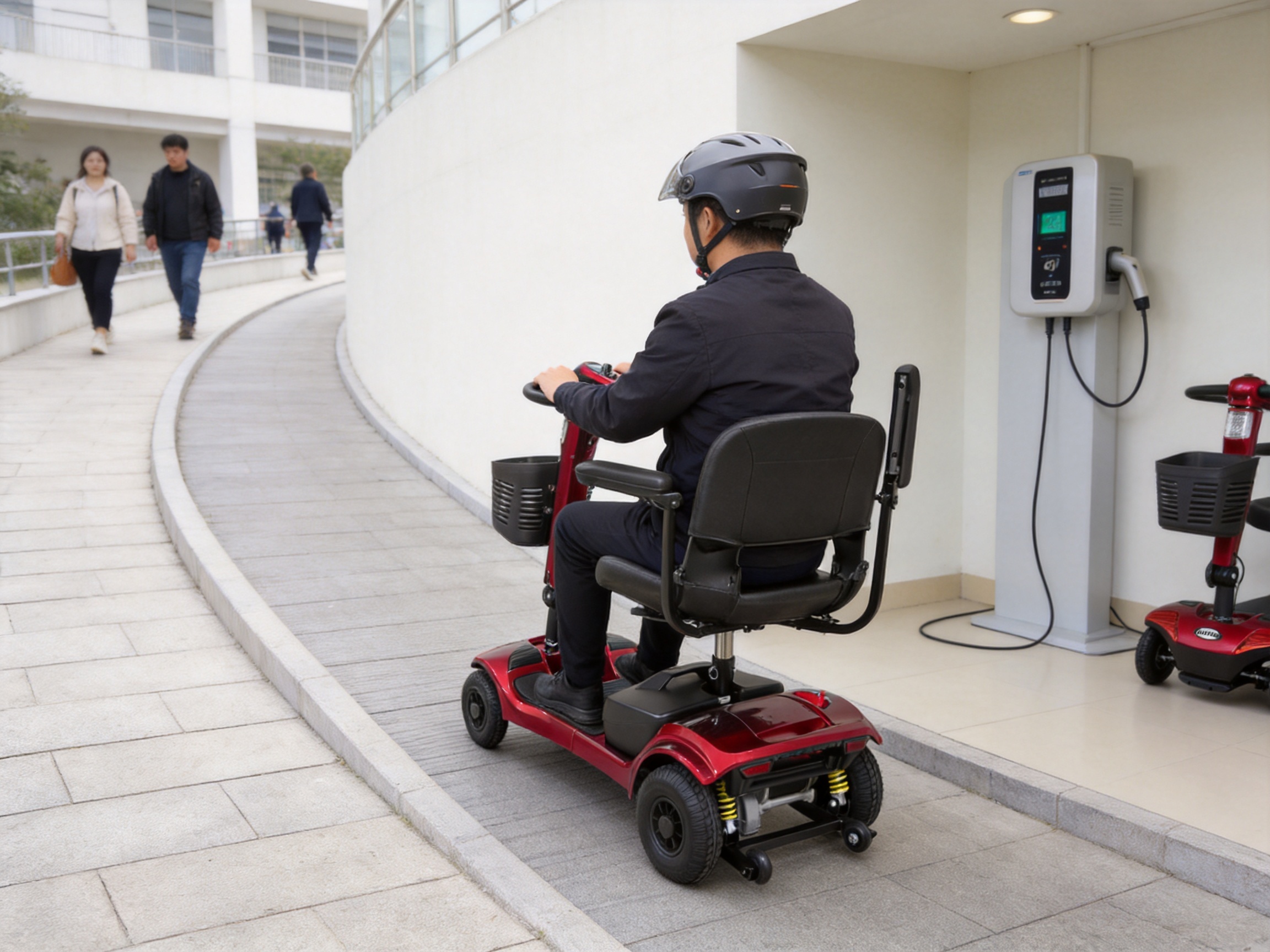
Charging habits have a direct effect on practical range and battery life. The scooter should generally be charged after use or according to the battery supplier’s guidance. The charger should be connected and disconnected in the correct sequence, and the battery should not be exposed to extreme heat, freezing conditions, water, or unauthorized modifications.
Range planning should be conservative. The stated 15–25 km range is a useful product reference, but it is not a promise that every journey will reach the upper end. A user traveling uphill, carrying a heavier load, driving over rough surfaces, or making frequent stops may experience a shorter range. Planning a return journey with reserve battery capacity is a sensible operating practice.
Electromagnetic Braking
The brake system is specified as an electromagnetic brake. This type of brake is commonly used on electric mobility scooters because it can engage when the drive control is released or the system is switched off, helping the scooter come to a controlled stop under normal conditions.
An electromagnetic braking system works together with the motor controller and drive system. It is not a substitute for responsible operation. Users should maintain a safe distance from obstacles, reduce speed before turning, and avoid stopping suddenly unless necessary. Brake performance can be influenced by slope, surface, load, battery condition, and mechanical condition.
Regular inspection is important. The tires should be checked for damage and suitable inflation where applicable. The control tiller, electrical connections, battery terminals, and braking response should be examined according to the maintenance schedule. Any unusual noise, delayed stopping, reduced control response, or electrical fault should be addressed before continued use.
Compared with a scooter that relies only on manual braking or an informal stopping method, an integrated electromagnetic system can provide a more consistent relationship between the control input and the stopping function. This is one of the product’s practical advantages for users who want a simple, electrically coordinated driving system.
Weight Capacity and Everyday Use
The SW1000L has a stated weight capacity of 136 kg, equivalent to 300 pounds. This rating should include the user and any carried items or accessories. Staying within the published capacity is essential for safe handling, braking performance, motor operation, tire loading, and battery range.
A 300-pound capacity gives the scooter a useful position in the compact travel category. Some small scooters are designed only for lighter users, while larger heavy-duty models may be difficult to transport or maneuver indoors. The SW1000L aims to provide a middle ground: a compact four-wheel platform with a capacity suitable for many adult users.
Weight capacity should not be viewed in isolation. A user’s height, seating position, balance, leg clearance, and ability to operate the controls are also important. The scooter should be evaluated in a practical setting whenever possible. A distributor or mobility specialist can help determine whether the configuration is appropriate for a particular user.
When carrying shopping bags or other items, the load should be secured and positioned so that it does not interfere with the steering tiller, wheels, controls, seat, or visibility. Excessive weight placed high or toward one side can affect balance. The scooter should never be used to transport more people than the design allows.
Comparison with Larger and Three-Wheel Alternatives
Competitor products in the mobility scooter market vary widely. Some are built as large outdoor scooters with higher ground clearance, larger batteries, wider seats, and greater travel capability. Others are three-wheel travel scooters designed to achieve a tight turning radius. The SW1000L occupies a practical position between these categories.
Compared with a larger outdoor scooter, the SW1000L may be easier to maneuver in confined locations because of its narrower 525 mm width and compact 1,110 mm length. It may also be easier for a user or caregiver to position in a home, shop, or indoor facility. Its 8 km/h speed and 15–25 km stated range are appropriate for moderate travel needs without requiring the size of a full outdoor touring model.
Compared with a three-wheel travel scooter, the SW1000L offers the potential stability advantages of four wheels. This can be meaningful for users who prefer a more balanced platform during straight travel and gentle turns. The trade-off is that a four-wheel scooter may not turn as tightly as a comparable three-wheel design. Buyers should therefore consider the spaces in which the scooter will be used.
Compared with highly complex premium scooters, the SW1000L has a relatively focused specification. Its 24 V motor system, electromagnetic braking, rear suspension, and lead-acid battery configuration are familiar technologies for distributors and service teams. This can simplify product education, routine maintenance, and parts planning.
Compared with very small portable scooters, the SW1000L offers a higher 300-pound capacity and a four-wheel configuration. Buyers should still confirm whether the scooter’s physical handling and transport requirements match their needs. A product designed for stability and capacity may not be as light as an ultra-portable model.
No single scooter is ideal for every user. The main competitive advantage of this model is its balance. It combines compact dimensions, a four-wheel layout, a practical capacity, moderate range, rear suspension, and a controlled 8 km/h top speed. This combination can appeal to users who want more support than a very small travel scooter while avoiding the bulk of a full-size outdoor model.
Manufacturing Experience and Product Development
Suzhou Sweetrich Vehicle Industry Technology Co., Ltd. is described as a high-tech company located in Suzhou Industrial Zone, Jiangsu, China. Established in 2011, the company has accumulated more than ten years of experience in the research, development, and production of mobility scooters and power wheelchairs.
The company’s stated facility covers approximately 60 acres and includes a factory of about 30,000 square meters. A dedicated manufacturing site of this scale can support multiple activities, including product development, component management, assembly, testing, quality control, packaging, and export preparation. The value of a manufacturing facility is not simply its size, but how effectively its people, processes, equipment, and quality systems are coordinated.
Sweetrich states that it owns intellectual property rights for its electric scooters and power wheelchairs. This indicates an emphasis on internal product development rather than relying only on generic, externally designed platforms. In practical terms, in-house development can allow a manufacturer to coordinate the frame, electrical system, control technology, driving characteristics, and user-focused details as a complete product.
The company also describes its products as incorporating advanced control technology and driving systems. For a mobility scooter such as the SW1000L, control technology is central to the user experience. The motor controller must work with the throttle or speed control, electromagnetic brake, battery, and motor to provide predictable movement. A well-coordinated system can help reduce abrupt response and make the scooter more approachable for everyday users.
Product development in this sector requires attention to both engineering and human factors. A scooter is used by people who may have different levels of strength, dexterity, balance, vision, and driving experience. Controls should therefore be understandable, the steering response should be manageable, and the scooter should communicate its operating state clearly through appropriate indicators and controls.
The SW1000L’s configuration reflects this type of practical development. Its compact dimensions address maneuverability, its four wheels address stability, its rear suspension addresses comfort, its electromagnetic brake addresses controlled stopping, and its moderate motor output addresses everyday travel. These elements work together as a system rather than as isolated specifications.
Production Management and Quality Focus
Sweetrich states that it follows strict production management and scientific product design. While individual quality procedures should be confirmed through the supplier’s current documentation, these principles are important in mobility product manufacturing. A scooter must perform consistently across repeated production batches, and quality must be considered from incoming components through final assembly.
Effective production management generally includes supplier control, incoming inspection, process control, assembly verification, electrical testing, functional testing, packaging inspection, and traceability. Battery connections, charger compatibility, motor wiring, controller settings, brake engagement, wheel installation, and structural fasteners all deserve attention during manufacturing and final inspection.
Quality control is particularly important because mobility scooters combine mechanical, electrical, and user-interface systems. A problem in one subsystem can affect the overall user experience. For example, a tire issue can influence handling, a battery connection issue can affect range, a controller issue can affect acceleration, and a brake issue can affect stopping performance.
A systematic manufacturing approach helps reduce variation. Standardized work instructions can ensure that assembly personnel follow the same procedures. Inspection checkpoints can identify problems before the product reaches packaging. Functional testing can verify that the completed scooter operates as intended rather than merely confirming that individual components are present.
For international buyers, production consistency is also commercially important. Distributors need products that match the specification agreed during purchasing. They need predictable packaging, repeatable parts, reliable documentation, and responsive technical communication. A manufacturer with long-term experience in export markets may be better positioned to understand these requirements.
Sweetrich reports that its products are exported to America, Europe, Japan, Australia, the Middle East, Russia, and other markets. Experience across multiple regions can expose a manufacturer to different user expectations, shipping conditions, electrical environments, regulatory requirements, and distributor service models. Such experience can support continuous refinement of products and production practices.
Design Strengths for Distributors and Fleet Buyers
The SW1000L is identified as ready to ship, which can be attractive to distributors and commercial buyers who need access to an established product rather than waiting for a new design to complete development. Ready-to-ship availability may help retailers manage seasonal demand, fulfill customer orders more efficiently, and maintain a practical inventory position.
The listed container loading quantities are 80 pieces per 20-foot general-purpose container and 200 pieces per 40-foot high-cube container. These figures provide a planning reference for international logistics. Actual loading may depend on packaging configuration, optional equipment, pallet use, documentation requirements, and the final shipping arrangement, so purchasers should confirm the details before placing an order.
A compact model can also be useful for fleet applications. Rental operators, senior living communities, hospitality venues, shopping facilities, and other organizations may value a scooter that is easier to store and move than a full-size model. The four-wheel layout and 300-pound capacity can support a broad user base, while the straightforward electrical system may help simplify routine fleet maintenance.
For retailers, the product offers several clear points for customer education: four-wheel stability, rear suspension, electromagnetic braking, a 5 mph maximum speed, a moderate travel range, and a compact body. These benefits can be explained without overpromising performance. Transparent communication about range, charging, terrain, and intended use helps create realistic customer expectations.
Maintenance and Service Considerations
Regular maintenance supports safe and reliable operation. Before use, the operator should check the general condition of the scooter, including the tires, seat, tiller, controls, battery connections, and brake response. Any loose component, visible damage, unusual sound, or change in driving behavior should be investigated.
The tires should be kept in suitable condition. Worn or damaged tires can reduce traction and affect braking and steering. If the tire design requires inflation, pressure should be checked according to the manufacturer’s instructions. If the tires are solid or non-pneumatic, they should still be inspected for cuts, excessive wear, or deformation.
The battery system should be kept clean and dry. Lead-acid batteries require appropriate charging and should not be stored in a severely discharged condition. The charger should be the correct 24 V unit specified for the scooter, and users should not replace it with an incompatible charger simply because the plug appears similar.
Electrical connectors should not be pulled by their wires, and unauthorized modifications should be avoided. Altering the controller, motor, charger, wiring, or braking system can affect performance and safety. Repairs should be carried out by qualified personnel using suitable replacement parts.
The frame and suspension area should be inspected periodically. Fasteners may require checking under the maintenance schedule, particularly if the scooter is used frequently or transported often. A service record can be useful for commercial fleets and for owners who want to monitor battery replacement, tire condition, and general wear.
Safe Operation Guidelines
The SW1000L should be operated only by a user who can understand the controls and maintain adequate control of the scooter. New users should begin in an open, level area with low pedestrian and vehicle traffic. They should practice starting, stopping, steering, reversing, and turning before attempting longer journeys.
Speed should be reduced in crowded locations, narrow passages, turns, slopes, and areas with uneven surfaces. The maximum speed is 8 km/h, but the safest speed may be substantially lower depending on the environment. Users should keep both hands positioned appropriately for steering and should avoid distractions while driving.
Curbs and steps should not be attempted unless the product documentation specifically permits the maneuver. The scooter should not be driven through deep water, over unstable ground, or on surfaces that may cause slipping. Weather conditions can affect traction and visibility, so route decisions should take rain, ice, mud, and poor lighting into account.
When the scooter is parked, the user should select a stable location and ensure that the scooter is not obstructing a doorway, ramp, emergency route, or pedestrian path. The electromagnetic brake should be engaged as designed, but users should also follow any parking and key-removal instructions supplied with the product.
Because this model is identified as a non-medical device for the United States market, it should not be represented as providing medical treatment, rehabilitation, or guaranteed clinical benefits. Its role is to provide powered mobility for appropriate users under suitable operating conditions.
How to Evaluate the Scooter Before Purchase
Prospective buyers should begin by identifying the main travel environment. If the scooter will be used mostly indoors or around compact paved areas, the SW1000L’s narrow width and moderate dimensions may be attractive. If the user requires extensive off-road travel, very long-distance operation, or heavy-duty obstacle clearance, a larger specialized model may be more suitable.
The user’s body size and weight should be compared with the stated 136 kg capacity and the physical dimensions of the scooter. Seat fit, leg position, tiller reach, and ease of control should be considered. A test drive, where available, can help determine whether the steering response, turning space, and seating position are appropriate.
Battery capacity should be confirmed at the quotation stage. The specification lists 12 V 12 Ah or 20 Ah batteries, two pieces. The selected configuration may affect the scooter’s range, weight, charging requirements, and price. Buyers should also confirm whether batteries are included, how they are packaged for shipment, and which replacement battery specifications are approved.
Buyers should request current product documentation, warranty terms, spare-parts information, charger details, packaging dimensions, and applicable market compliance documents. These items are particularly important for importers and distributors who must support customers after delivery.
Frequently Asked Questions
What type of product is the SW1000L?
The SW1000L is a compact four-wheel electric mobility scooter in the Travel Smart Scooters category. It is intended for personal mobility and transportation. The supplied information identifies it as a non-medical device for the United States market.
What is the maximum speed?
The maximum forward speed is 8 km/h, or approximately 5 miles per hour. Actual operating speed should be adjusted to the surroundings, surface, traffic, visibility, and user experience.
What is the stated driving range?
The stated maximum driving range is 15–25 km, or approximately 9.5–15.5 miles. Actual range depends on battery capacity, user weight, terrain, temperature, surface, tire condition, driving habits, and battery age.
How much weight can the scooter support?
The published weight capacity is 136 kg, equivalent to 300 pounds. This figure should include the user and any carried belongings or accessories.
Does the scooter have four wheels?
Yes. The SW1000L is a four-wheel scooter with 8-inch front tires and 9-inch rear tires. The four-wheel layout is intended to provide a balanced and stable platform for suitable everyday travel.
Does it include suspension?
The specification lists rear suspension. Suspension may improve comfort over minor irregularities, but the scooter is not intended for severe off-road terrain or large obstacles.
What kind of brake does it use?
The scooter uses an electromagnetic brake system. Users should still operate at a safe speed, maintain awareness of their surroundings, and arrange inspection if braking performance changes.
What motor does the scooter use?
The motor is specified as a 24 V/300 W unit. It is designed for the scooter’s compact travel application and rated operating conditions.
What batteries are available?
The battery specification lists lead-acid 12 V 12 Ah or 20 Ah batteries, with two batteries used in the system. The exact configuration should be confirmed with the supplier before ordering.
How long does charging take?
The stated charging time is approximately 6–8 hours. Charging time can vary according to battery capacity, battery condition, remaining charge, charger output, and surrounding temperature.
What charger is supplied?
The charger is specified as DC 24 V/2 A with an AC input range of 100–240 V. Buyers should confirm the regional plug, certification requirements, and final charger configuration for their market.
Can the scooter climb hills?
The maximum driving gradient is listed as 10 degrees. Incline performance depends on the total load, battery charge, surface condition, tire condition, slope length, and other factors. Users should avoid slopes that exceed the rated limit and should operate cautiously on all inclines.
Is this scooter a medical device?
The supplied product information describes it as a non-medical device for the United States market. It should not be promoted as a medical treatment or as a substitute for professional medical advice.
Who manufactures the scooter?
The product is supplied by Suzhou Sweetrich Vehicle Industry Technology Co., Ltd., also known as Sweetrich Mobility in the provided company information. The company is located in Suzhou, Jiangsu, China, and manufactures mobility scooters and power wheelchairs.
What manufacturing experience does the company have?
The company was established in 2011 and states that it has more than ten years of experience in research, development, and production. It reports a 60-acre site with a 30,000-square-meter factory and exports products to multiple international markets.
Is the product suitable for distributors?
The product is described as ready to ship, and container loading information is provided as 80 pieces per 20-foot general-purpose container and 200 pieces per 40-foot high-cube container. Distributors should confirm current availability, packaging, shipping specifications, and order terms directly with the supplier.
Conclusion
The SW1000L Ready to Ship Mobility Scooter is designed for buyers who want a practical balance of compact size, four-wheel stability, moderate range, and straightforward operation. Its 525 mm width and 1,110 mm length support maneuverability in many everyday environments, while the 136 kg capacity gives it a useful position among compact travel scooters.
The product’s main functional strengths include an 8 km/h maximum speed, a 24 V/300 W motor, a stated 15–25 km range, rear suspension, electromagnetic braking, and a four-wheel tire arrangement. These features make it a candidate for local travel, indoor and outdoor paved environments, residential use, and other suitable applications within the rated limits.
Its competitive value comes from its balanced specification rather than from extreme performance. It is more substantial than some very small travel scooters while remaining more compact than many full-size outdoor models. The four-wheel design favors a stable platform, the rear suspension supports comfort, and the familiar lead-acid battery system can be practical for established distribution and service networks.
The manufacturer’s stated experience, dedicated factory, intellectual property, product development capabilities, export reach, and emphasis on production management provide additional value for commercial buyers. As with any mobility product, correct user fit, responsible operation, proper charging, regular maintenance, and compliance with local requirements are essential.
For retailers, importers, fleet operators, and end users seeking a compact four-wheel mobility scooter for everyday travel, the SW1000L offers a clear and practical configuration. Final purchasing decisions should be based on confirmed battery options, current documentation, user requirements, local regulations, and the intended travel environment.
References
Sweetrich Mobility. SW1000L product specification and technical data supplied for product information purposes.
Suzhou Sweetrich Vehicle Industry Technology Co., Ltd. Company profile and manufacturing information supplied for product presentation purposes.
General principles of electric mobility scooter operation, battery care, charging safety, tire inspection, and routine maintenance.
Applicable local regulations and user guidance for powered mobility devices in the intended market.