 info@sweetrich.cn
  +86-(0)512-82283871
Content
- 1 Designed for Everyday Travel and Personal Independence
- 2 Key Specifications at a Glance
- 3 Portability as a Primary Advantage
- 4 Four-Wheel Stability in a Compact Package
- 5 Driving Range and Battery Configuration
- 6 Motor Performance for Routine Mobility
- 7 Suspension, Tires, and Surface Comfort
- 8 Electromagnetic Braking and Controlled Operation
- 9 Comfort and User-Focused Design
- 10 How the S1 Sport Compares with Common Alternatives
- 11 Manufacturing Experience and Product Development Strengths
- 12 International Market Experience
- 13 Quality Principles and Customer Support
- 14 Practical Use Cases
- 15 Maintenance and Ownership Recommendations
- 16 Safety Considerations
- 17 Purchasing Checklist
- 18 Frequently Asked Questions
- 18.1 What type of product is the S1 Sport?
- 18.2 What is the maximum speed?
- 18.3 What is the maximum driving range?
- 18.4 How much weight can the scooter carry?
- 18.5 Is the scooter easy to transport?
- 18.6 Does it have four wheels?
- 18.7 What battery does it use?
- 18.8 How long does charging take?
- 18.9 What type of brake system is fitted?
- 18.10 Can it climb hills?
- 18.11 Does the scooter include suspension?
- 18.12 Who manufactures the scooter?
- 18.13 What should buyers confirm before ordering?
- 19 Conclusion
- 20 References
- 21 Product: S1 Sport Easy Travel 4 Wheel Ultra Light Foldable Electric Mobility Scooter for Old People
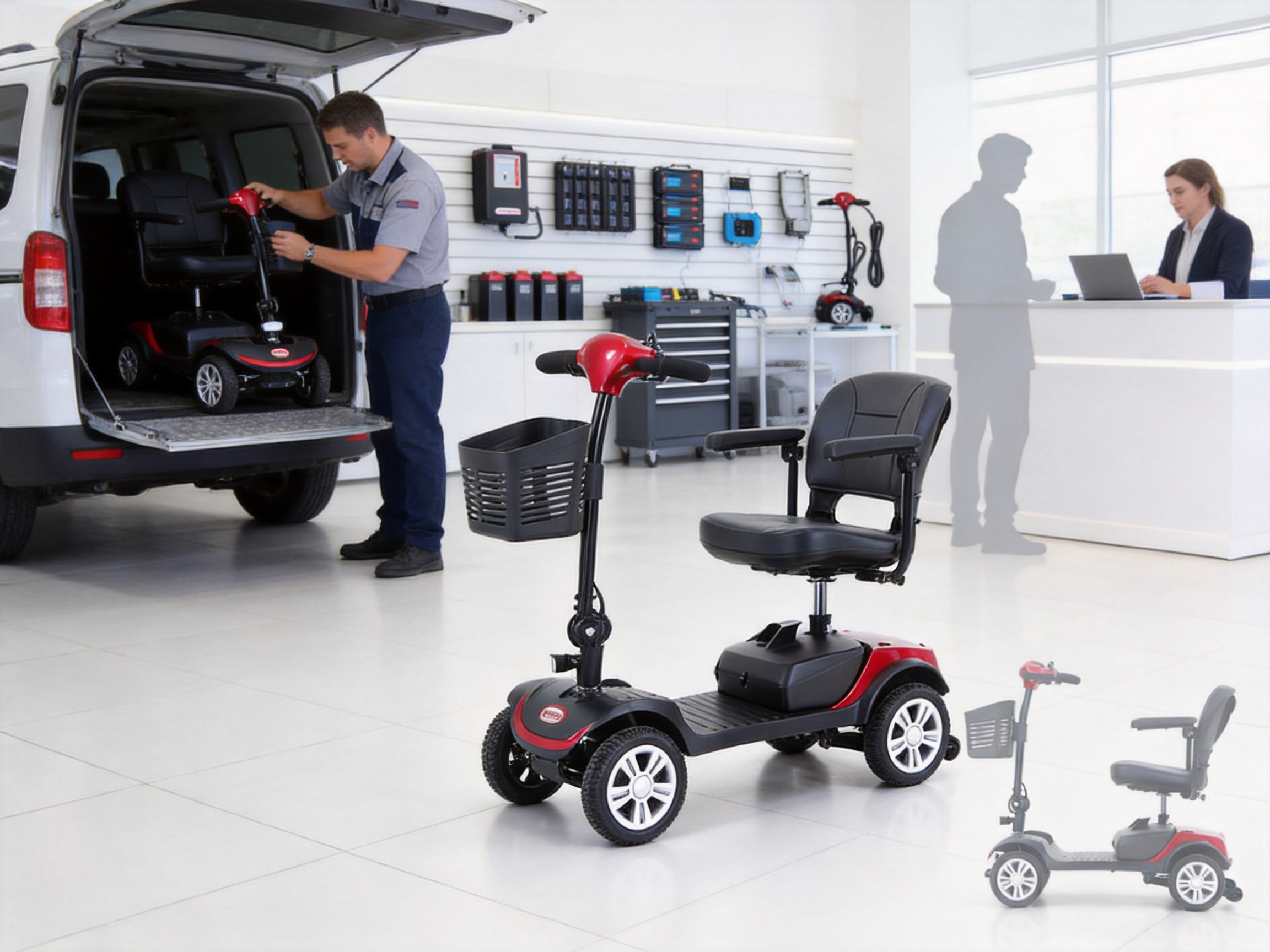
Choosing a mobility scooter for travel involves more than selecting a vehicle with a motor and four wheels. A practical travel scooter must combine portability, stability, straightforward controls, useful driving range, dependable braking, and a comfortable driving position. It must also be light enough to handle when separated into transportable sections. The S1 Sport Easy Travel 4 Wheel Ultra Light Foldable Electric Mobility Scooter is designed around these everyday requirements.
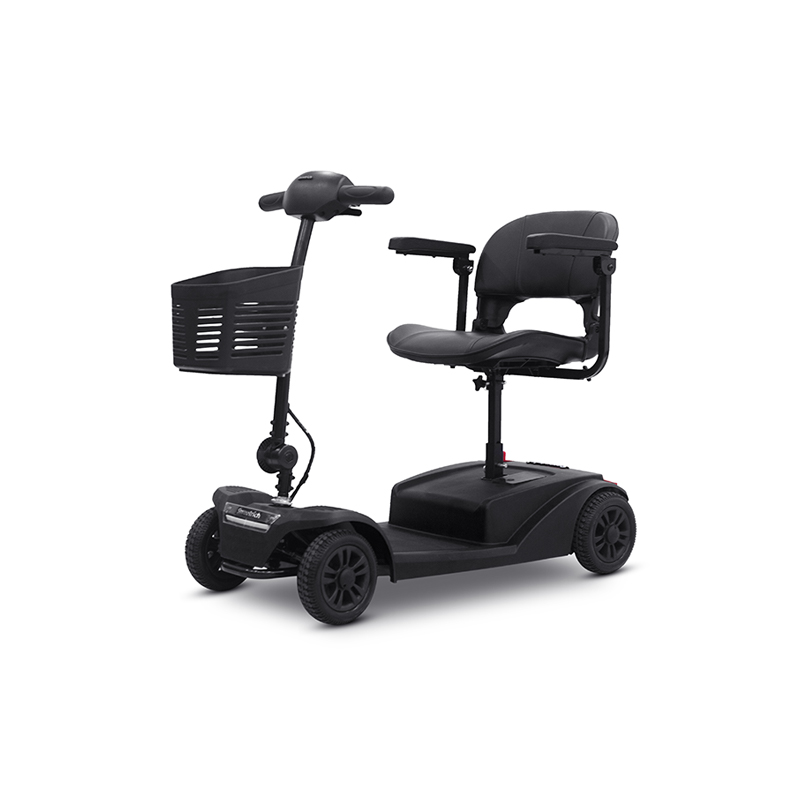
Classified as a Travel Smart Scooter, the S1 Sport is intended for people who want additional mobility for shopping, visiting family, traveling, and moving around suitable indoor and outdoor environments. Its four-wheel layout gives it a balanced footprint, while its folding design and 27-kilogram heaviest part are intended to simplify loading and storage. The scooter offers a maximum forward speed of 8 km/h, a stated driving range of 15 to 25 kilometers, and a weight capacity of up to 120 kilograms.
This article examines the scooter’s design, specifications, travel benefits, comfort features, safety systems, battery options, and manufacturing background. It also explains how the model compares with common alternatives in the travel-scooter category and provides practical answers to frequently asked questions.
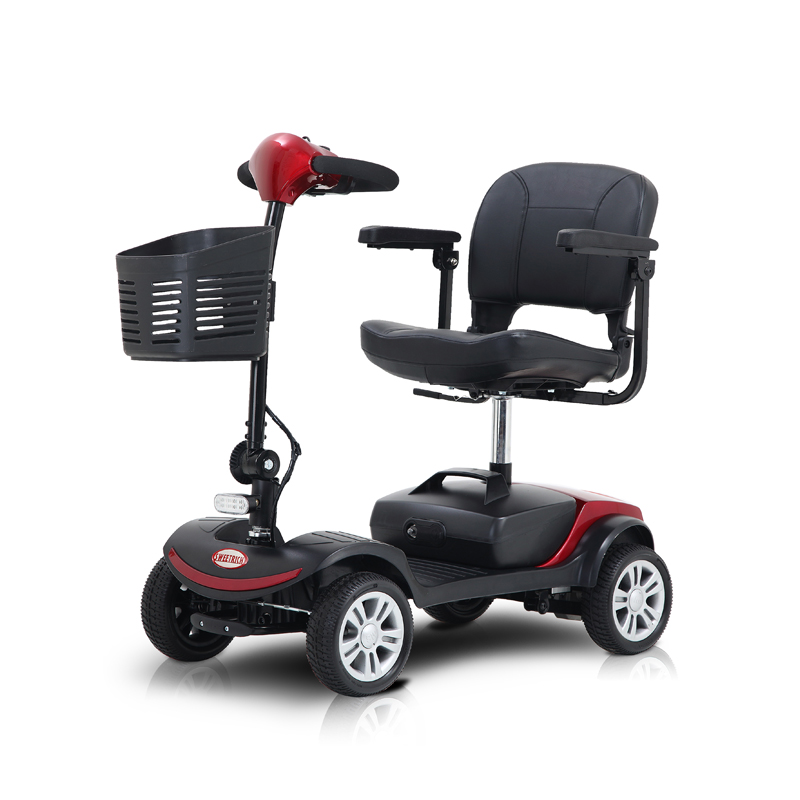
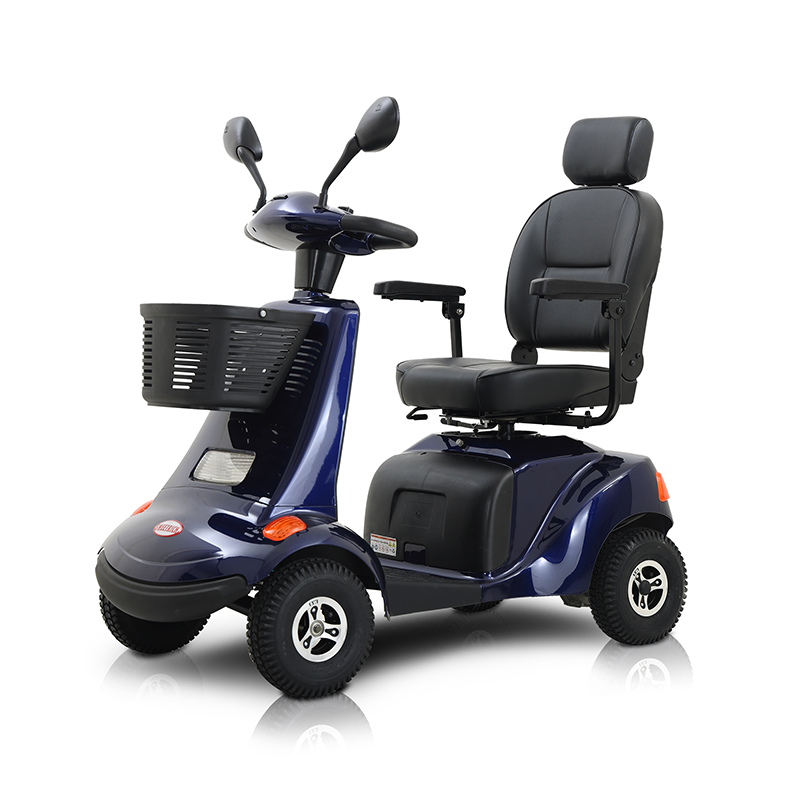
S1 Sport Easy Travel 4 Wheel Ultra Light Foldable Electric Mobility Scooter for Old People
Designed for Everyday Travel and Personal Independence
The central purpose of a travel scooter is to make ordinary activities more accessible. Users may need a scooter for a short trip through a shopping center, a visit to a park, transportation around a holiday destination, or movement across a large home or residential community. In these situations, portability can be as important as maximum power.
The S1 Sport is designed to address this balance. It is an electric four-wheel scooter with a compact overall length of 1,110 millimeters, a width of 525 millimeters, and a height of 920 millimeters. These dimensions give the scooter a relatively narrow profile compared with many full-size mobility scooters. A narrower frame can be useful in corridors, doorways, store aisles, and other spaces where a larger scooter may be difficult to maneuver.
The product is also intended for users who prefer the reassurance of four wheels. Three-wheel scooters can offer a tight turning circle, but four-wheel models generally provide a broader and more balanced support base. The S1 Sport’s configuration is therefore suitable for users who place value on steady handling and a confident seating position during routine travel.
The scooter is described as a non-medical device for the United States market. It should therefore be viewed as a personal mobility product rather than as a clinical treatment device. Users should consider their own physical needs, driving environment, local regulations, and advice from an appropriate healthcare or mobility professional before purchasing or operating any scooter.
Key Specifications at a Glance
The following table summarizes the principal specifications supplied for the S1 Sport model. Actual performance can vary depending on battery condition, rider weight, terrain, temperature, tire pressure, driving style, and other operating conditions.
| Specification | Details |
|---|---|
| Product type | Four-wheel foldable electric mobility scooter |
| Category | Travel Smart Scooters |
| Dimensions | 1,110 × 525 × 920 mm (length × width × height) |
| Maximum forward speed | 8 km/h (5 mi/h) |
| Maximum driving gradient | 10 degrees |
| Maximum driving range | 15–25 km (9.5–15.5 miles) |
| Weight capacity | 120 kg (265 lb) |
| Suspension | Rear suspension |
| Tire size | 9 × 3 inches front and rear |
| Brake system | Electromagnetic brake |
| Battery options | Lead-acid 12 V 12 Ah or 20 Ah, two batteries; 20 Ah optional |
| Charger | DC 24 V 2 A, AC 100–240 V |
| Charging time | Approximately 6 hours |
| Motor | 24 V / 300 W |
| Motor controller | 24 V / 50 A dynamic controller |
| Heaviest part | 27 kg (60 lb) |
Portability as a Primary Advantage
Many mobility scooters are comfortable to drive but difficult to transport. A heavy one-piece frame may require a vehicle lift, a large van, or assistance from another person. For users who travel frequently, this can limit the practical value of the scooter.
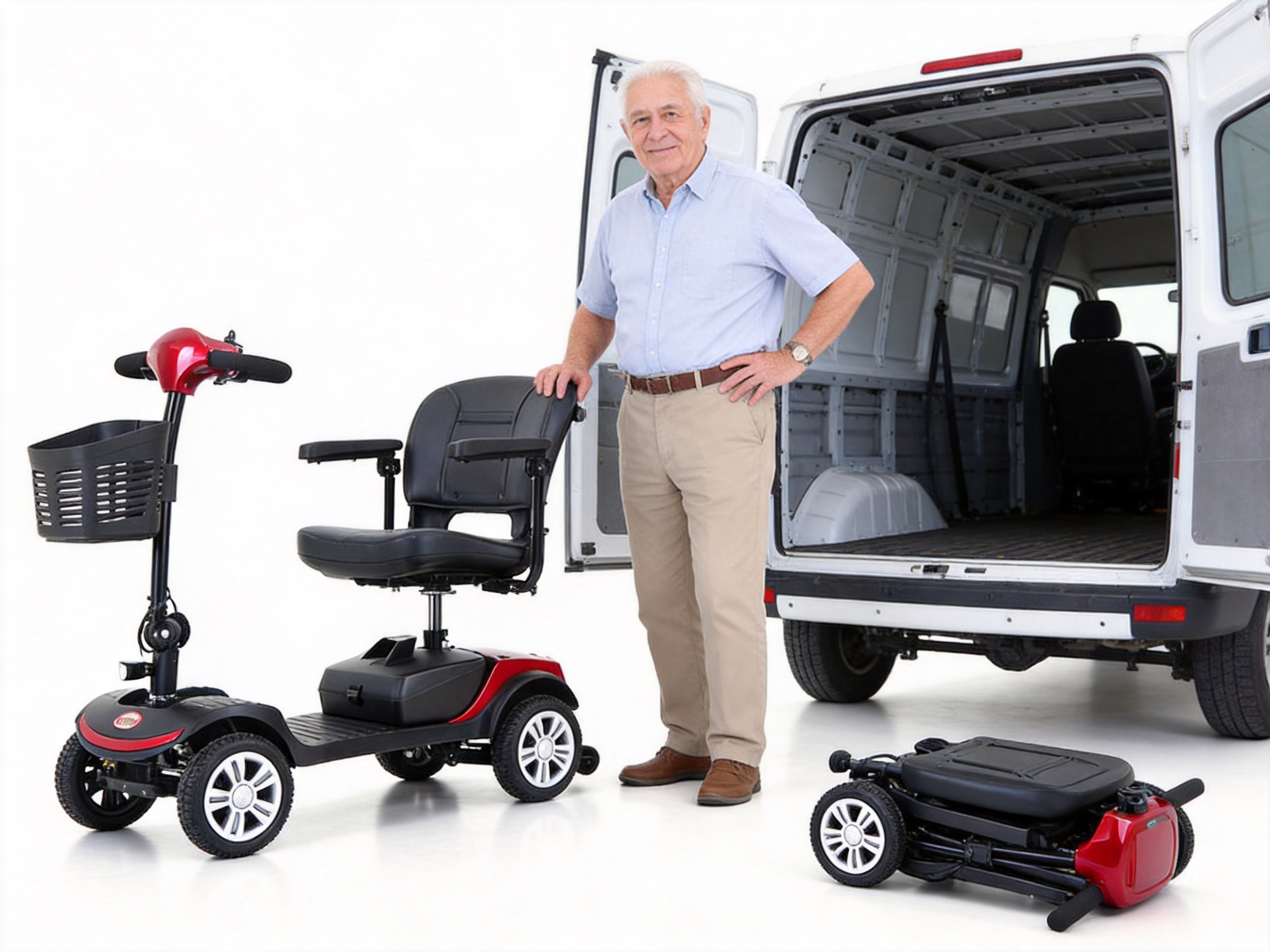
The S1 Sport addresses this issue with a foldable design and a stated heaviest-part weight of 27 kilograms. Although 27 kilograms is still substantial and users should use safe lifting practices, separating or folding the scooter can make it more manageable than a heavier full-size model. The design is particularly relevant for users who need to place a scooter in a vehicle, store it in a home, or move it between rooms and transport locations.
Compared with many standard mobility scooters, an ultra-light travel configuration can reduce the amount of equipment needed for transportation. A full-size scooter may require a permanent external carrier or a powered hoist. A foldable travel scooter may instead be suitable for a vehicle’s cargo area, provided that the vehicle dimensions and user’s lifting ability are appropriate.
Portability also affects storage. The S1 Sport can be useful in apartments, retirement communities, offices, and homes where storage space is limited. Its compact dimensions may allow it to be stored in a designated indoor area rather than left outdoors. Indoor storage can help protect the scooter from rain, excessive heat, cold, and other environmental conditions that may shorten the life of electrical components or batteries.
Users should confirm the folded dimensions and folding method before purchase, because the supplied specifications list the operating dimensions rather than the folded size. They should also check whether the scooter can be lifted safely, whether the battery must be removed for transportation, and whether the scooter is compatible with their vehicle.
Four-Wheel Stability in a Compact Package
The S1 Sport combines a compact travel format with four-wheel support. This is a significant design choice. A four-wheel chassis can help distribute the user’s weight across a broader base and may feel more stable when driving in a straight line or making gradual turns.
The 525-millimeter width is relatively compact for a four-wheel scooter. This can help the vehicle fit through many standard passageways and maneuver around furniture, retail displays, and other obstacles. Users should still measure their doorways and turning spaces, particularly in older buildings or homes with narrow entrances.
Stability is influenced by more than the number of wheels. Speed, slope, tire condition, rider posture, surface quality, and turning technique all affect safe operation. Even though the scooter is specified for gradients of up to 10 degrees, users should approach slopes carefully, avoid sudden turns on inclines, and follow the operating instructions supplied with the product.
The relatively moderate maximum speed of 8 km/h, or approximately 5 miles per hour, is appropriate for a travel-focused mobility scooter. It provides useful movement over short and medium distances while encouraging controlled operation in crowded or shared spaces. Lower speed settings may be preferable indoors, near pedestrians, or on uneven surfaces.
Driving Range and Battery Configuration
The stated maximum driving range is 15 to 25 kilometers, equivalent to approximately 9.5 to 15.5 miles. This range is suitable for many daily activities, including shopping trips, local visits, indoor facilities, and planned travel routes. The actual distance available from one charge will depend on the battery option and operating conditions.
Factors that may reduce range include heavier loads, repeated hill climbing, frequent acceleration and braking, low tire pressure, rough terrain, cold temperatures, battery age, and long periods of high-speed operation. For this reason, users should plan journeys with a reasonable reserve rather than treating the maximum published range as a guaranteed distance.
The scooter uses a 24-volt battery system with two lead-acid batteries. The listed configuration includes 12 V 12 Ah batteries, with a 20 Ah option available. The higher-capacity option may be selected by customers who prioritize additional operating range, although the increased battery capacity may affect total weight, charging requirements, and transport handling. Buyers should confirm the exact battery configuration supplied with their order.
Lead-acid batteries are widely used in mobility products because they are familiar, serviceable, and generally cost-effective. They do require appropriate charging and storage practices. The scooter should be charged with the supplied or approved charger, and the batteries should not be left completely discharged for extended periods. Users should follow the manufacturer’s instructions concerning storage, maintenance, replacement, and disposal.
The supplied charger is rated at DC 24 V and 2 A, with an AC input range of 100 to 240 V. This broad input range can be convenient for customers in different electrical markets, but the correct plug arrangement and local electrical requirements should always be confirmed. The stated charging time is approximately six hours, allowing the scooter to be charged overnight or between daily activities.
Motor Performance for Routine Mobility
The S1 Sport uses a 24 V, 300 W motor. This motor is configured for practical travel rather than high-speed recreational use. Its purpose is to provide controlled propulsion for everyday mobility on suitable paved and moderately inclined surfaces.
A 300 W motor can offer an effective balance between energy consumption, weight, and usable performance in a compact scooter. The motor is supported by a 24 V, 50 A dynamic motor controller. The controller manages the relationship between the user’s input and the motor’s response, helping the scooter deliver predictable acceleration and speed control.
For users, smooth response is often more valuable than maximum power. Predictable acceleration can make it easier to start in a confined space, approach a doorway, or move through a public area. It can also reduce the likelihood of abrupt movement caused by overly aggressive throttle response.
The scooter is specified for a maximum driving gradient of 10 degrees. This figure should be understood as a technical limit under defined test conditions rather than a recommendation for every journey. Real-world slope performance depends on the rider’s weight, battery charge, surface traction, slope length, and whether the scooter is turning or stopping. Users should avoid slopes that appear unsafe and should consult the operating manual for detailed restrictions.
Suspension, Tires, and Surface Comfort
The S1 Sport includes rear suspension. Suspension can help reduce the transmission of some vibration from the driving surface to the frame and seat, particularly when traveling over minor imperfections. Rear suspension is a useful feature for a compact scooter because small wheels and a lightweight frame can otherwise make uneven surfaces feel pronounced.
The scooter uses 9-by-3-inch tires at both the front and rear. This consistent tire size simplifies the overall design and gives the scooter a clear, balanced stance. Tire condition is important for traction, braking, comfort, and range. Users should inspect the tires regularly, maintain the recommended pressure where applicable, and replace damaged or excessively worn tires.
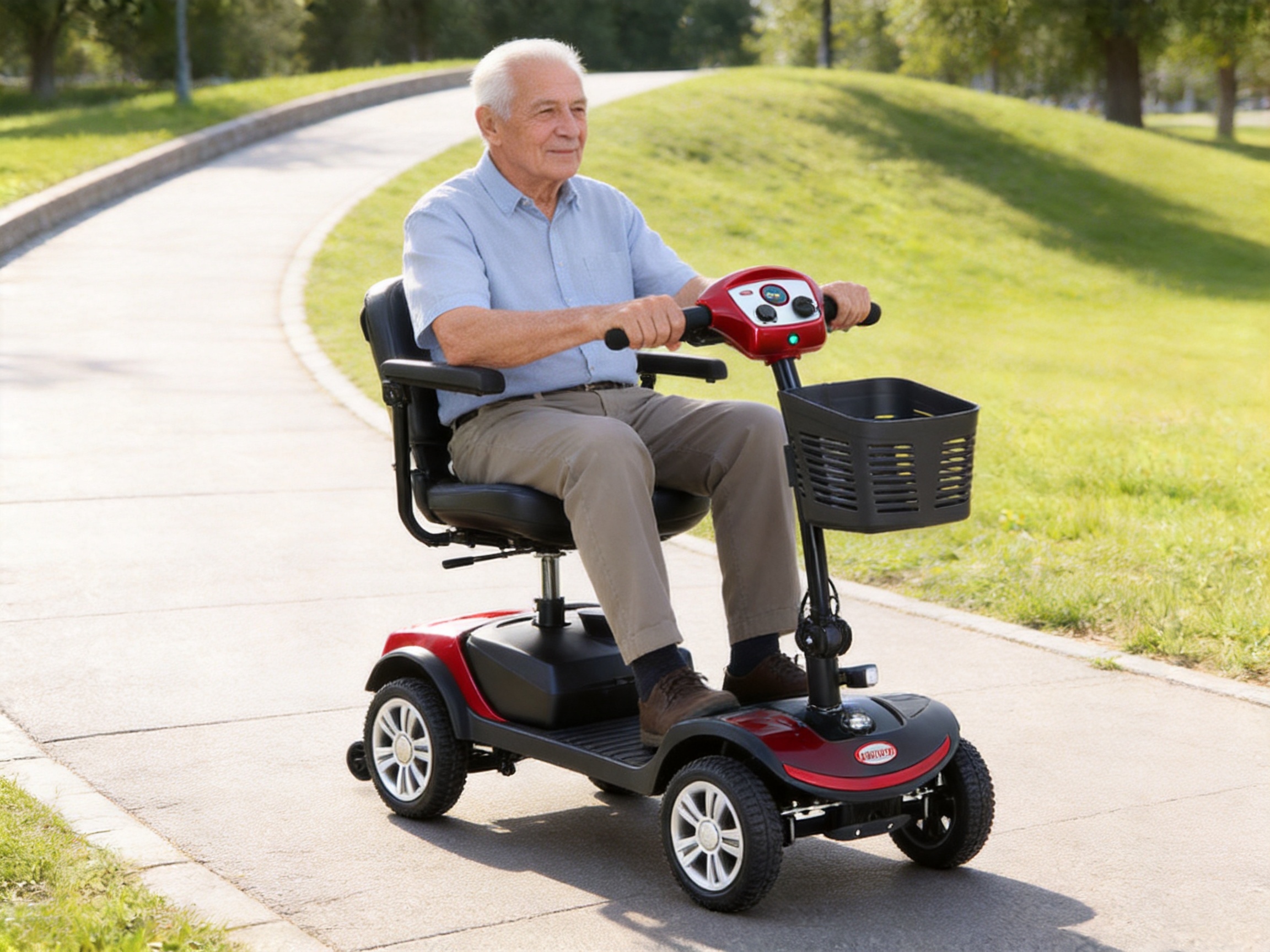
The product is best suited to appropriate paved paths, indoor floors, sidewalks where permitted, shopping areas, and other maintained surfaces. It is not designed to replace an all-terrain vehicle. Gravel, deep grass, mud, standing water, steep cross-slopes, and heavily broken surfaces can create risks even when a scooter has four wheels and suspension.
Driving technique also influences comfort. Reducing speed before uneven surfaces, crossing small thresholds at a suitable angle, keeping both hands in the correct position, and avoiding sudden steering inputs can help the user maintain control.
Electromagnetic Braking and Controlled Operation
The S1 Sport is equipped with an electromagnetic brake system. Electromagnetic braking is widely used in powered mobility scooters because it can engage when the drive control is released, helping bring the scooter to a controlled stop. This type of braking is especially useful for users who may find a conventional hand-operated brake difficult to manage.
Braking performance depends on battery condition, surface traction, speed, slope, rider weight, and mechanical condition. Users should test the brake system in a safe, open area before operating in public spaces. They should also avoid relying on the brake to compensate for excessive speed or unsafe downhill driving.
Routine inspection is important. If the scooter behaves unexpectedly, rolls when the controls are released, produces unusual noise, or takes longer than expected to stop, operation should cease until the vehicle has been inspected by a qualified service provider or according to the manufacturer’s service procedure.
Safe use also includes checking the route before driving. Pedestrians, curbs, ramps, door thresholds, wet areas, and crowded spaces require careful speed control. The compact design makes the scooter convenient, but it does not remove the need for responsible operation.
Comfort and User-Focused Design
A mobility scooter must be usable for the length of a typical journey. Comfort affects posture, confidence, and the user’s willingness to remain active. The S1 Sport is designed as a seated personal mobility vehicle, with a compact frame intended to support routine travel without the size and complexity of a full-size scooter.
Users should evaluate seat dimensions, tiller position, legroom, control placement, and ease of mounting before purchase. These factors are personal and can vary significantly between users. A product may be technically compact but still need to be adjusted correctly to provide a comfortable driving position.
The scooter’s moderate speed and electromagnetic braking system can support a controlled driving experience. The rear suspension and four-wheel structure add further practical features for users who want a stable and reasonably comfortable ride on suitable surfaces.
Because the model is described as suitable for elderly users and people seeking easier travel, controls should be operated with attention to hand strength, vision, coordination, and reaction time. Customers should request product documentation and, where possible, arrange a demonstration before purchase.
How the S1 Sport Compares with Common Alternatives
The travel mobility-scooter market includes three-wheel scooters, full-size four-wheel scooters, heavy-duty models, and lightweight folding scooters. Each type serves a different purpose. The S1 Sport’s advantages are most apparent when portability, compact dimensions, and four-wheel balance are more important than extreme range or high load capacity.
Compared with Full-Size Mobility Scooters
Full-size scooters commonly offer larger seats, greater battery capacity, higher load ratings, and stronger performance over longer routes. However, they may be heavier and more difficult to transport. They can also require more storage space and a vehicle lift.
The S1 Sport is more travel-oriented. Its 27-kilogram heaviest part and compact 525-millimeter width may make it easier to handle and store than a larger model. The trade-off is that users who need a very high weight capacity, extensive suspension, or long-distance daily travel may require a larger scooter.
Compared with Three-Wheel Travel Scooters
Three-wheel travel scooters may turn more tightly, which can be useful in particularly confined indoor spaces. However, some users prefer the balanced feel of four wheels. The S1 Sport offers four-wheel support while maintaining a relatively narrow travel profile.
The choice depends on the user’s environment and priorities. Customers should compare turning space, stability, seat position, transport weight, and route conditions rather than selecting solely on the number of wheels.
Compared with Non-Folding Travel Scooters
Some compact scooters can be disassembled but do not fold. Disassembly can make individual components lighter, but it may take more time and require several separate pieces to be stored. A folding design can provide a faster transition between driving and transport, subject to the exact folding mechanism and user strength.
The S1 Sport’s emphasis on folding and a manageable heaviest part is a practical advantage for users who regularly place the scooter in a vehicle or move it into storage.
Compared with Heavy-Duty Scooters
Heavy-duty scooters are designed for greater carrying capacity and more demanding outdoor use. They may provide stronger motors, larger tires, and longer range, but these features usually increase weight and size. The S1 Sport is not intended to compete directly with that class. Its advantage is convenience for lighter-duty personal transportation.
Manufacturing Experience and Product Development Strengths
The manufacturer, Suzhou Sweetrich Vehicle Industry Technology Co., Ltd., was established in 2011 and is located in Suzhou Industrial Zone, Jiangsu, China. The company reports a 60-acre site with a 30,000-square-meter factory. Its manufacturing focus includes mobility scooters and power wheelchairs.
More than ten years of experience in research, development, and production can support the refinement of product details such as chassis layout, folding mechanisms, motor control, braking integration, battery placement, and user ergonomics. In a mobility product, these systems must operate together. A folding frame must remain sufficiently secure during driving; the electrical system must work with the controller and brake; and the battery arrangement must support both performance and transport requirements.
The company states that it owns intellectual property rights relating to its electric scooters and power wheelchairs. Intellectual property development can indicate an emphasis on designing and improving proprietary product structures and control solutions rather than relying exclusively on generic configurations.
The manufacturer also describes the use of advanced control technology and driving systems intended to support smooth and safe operation. For the S1 Sport, the 24 V dynamic motor controller and electromagnetic braking system are important examples of the electrical and control architecture used in the product.
Strict production management and scientific product design are identified as key principles of the company’s approach. These principles are important in mobility manufacturing because product reliability depends on repeatable assembly, consistent inspection, correct wiring, secure fasteners, battery quality, and functional testing.
A dedicated factory environment can also support coordination between engineering, production, quality control, purchasing, and after-sales service. This is especially valuable for export products, where consistent specifications and replacement-part support are important to distributors and end users.
International Market Experience
The manufacturer reports that its products are exported to America, Europe, Japan, Australia, the Middle East, Russia, and other markets. International distribution requires attention to different customer expectations, electrical systems, packaging requirements, documentation, and local market rules.
For buyers in the United States, it is important to distinguish between a product’s intended market and formal regulatory approval. The supplied description identifies the S1 Sport as a non-medical device for the US market. Customers and distributors should independently confirm applicable compliance, labeling, shipping, battery, and accessibility requirements before placing an order or selling the product.
Export experience can nevertheless be useful because it exposes a manufacturer to different operating environments and customer requirements. It may also support the development of multilingual documentation, packaging processes, international logistics procedures, and distributor communication.
Quality Principles and Customer Support
The company states that it follows the principles of quality first, credit above, and customer supreme. While statements of principle do not replace independent product evaluation, they indicate the manufacturer’s stated emphasis on reliability, business relationships, and customer service.
For a mobility scooter, customer support should include clear operating instructions, battery guidance, maintenance information, spare-part availability, warranty terms, and a process for handling technical questions. Distributors should confirm which components are stocked locally and how service requests are managed.
Before purchase, buyers should request a complete specification sheet and confirm the supplied configuration. Important points include the exact battery capacity, folded dimensions, total weight, seat details, color availability, warranty coverage, charger plug, replacement battery type, and delivery packaging.
Long-term satisfaction depends on matching the product to the user and the environment. A manufacturer can provide a well-designed scooter, but the buyer must still select a suitable model, use it within its limits, and maintain it properly.
Practical Use Cases
The S1 Sport can be considered for several everyday situations:
Shopping and retail visits: The compact width and moderate speed can be useful in suitable stores, malls, and market areas. Users should follow venue policies and remain alert around other shoppers.
Travel and vacations: The folding design and manageable heaviest part may simplify transport by car. Users should confirm airline, railway, coach, or hotel policies before traveling and should protect the scooter during loading.
Residential communities: Four-wheel support, rear suspension, and electromagnetic braking can be helpful for routine movement around appropriate paths and shared facilities.
Home use: The relatively narrow frame may help the scooter pass through many interior spaces. Doorway measurements should be taken before purchase.
Short outdoor journeys: The stated range of up to 25 kilometers may support planned local travel, subject to terrain, rider weight, battery condition, and weather.
These use cases are examples rather than guarantees. The scooter should only be used on routes and surfaces that are safe and permitted by local rules.
Maintenance and Ownership Recommendations
Regular maintenance helps preserve safety and performance. Before each journey, users should check the battery indicator, tires, steering response, seat position, folding-frame security, and brake operation. Loose components, damaged wiring, unusual noises, or changes in handling should be investigated promptly.
The scooter should be kept clean and dry. Water should not be directed at electrical components, the controller, charger, or battery connections. If the scooter has been exposed to rain, it should be dried appropriately before charging or storage.
Battery charging should take place in a suitable, ventilated area using the correct charger. The charging connector should be inspected for damage, and the charger should be disconnected according to the instructions after charging is complete. Batteries should be replaced as a matched and approved set where required.
Tire pressure and tread condition influence both comfort and range. Underinflated tires can increase rolling resistance, while damaged tires can reduce control. The electromagnetic brake and motor controller should not be modified by unqualified persons.
When transporting the scooter, the folding mechanism should be fully secured. The scooter should be restrained inside a vehicle so that it cannot move during acceleration, braking, or turning. Users should avoid lifting beyond their safe ability and should request assistance when necessary.
Safety Considerations
Users should read the complete manual before operating the S1 Sport. They should practice starting, stopping, reversing, turning, and changing speed in an open area before traveling near traffic or pedestrians.
Seat belts, lights, reflectors, mirrors, and other equipment should be used where provided or required. Local laws may govern sidewalk use, road crossings, nighttime operation, and maximum permitted speeds.
Slopes require particular caution. The stated 10-degree maximum gradient does not mean every 10-degree slope is safe in every condition. Wet surfaces, loose gravel, side slopes, uneven transitions, and heavy loads can reduce traction and stability. Users should approach ramps straight on where possible and avoid abrupt steering movements.
The scooter should not be used by a person whose condition prevents safe control of the vehicle. Professional advice may be appropriate for users with limited vision, reduced hand strength, balance concerns, or other conditions that affect mobility-scooter operation.
Purchasing Checklist
Before ordering, prospective buyers should confirm the following:
First, verify that the 120-kilogram weight capacity is suitable for the user and any carried items. Second, compare the 27-kilogram heaviest part with the user’s lifting ability and vehicle-loading plan. Third, determine whether the standard 12 Ah battery or optional 20 Ah battery is appropriate.
Next, measure doorways, storage areas, vehicle cargo spaces, and turning locations. Ask for the folded dimensions if they are not listed in the quotation. Confirm the charger specification and plug type for the destination country.
Buyers should also discuss warranty coverage, spare parts, battery replacement, technical support, delivery packaging, and after-sales service with the distributor. A demonstration or sample evaluation can help verify the scooter’s comfort and handling.
Frequently Asked Questions
What type of product is the S1 Sport?
The S1 Sport is a four-wheel foldable electric mobility scooter in the Travel Smart Scooters category. It is described as a non-medical device intended for the United States market.
What is the maximum speed?
The listed maximum forward speed is 8 km/h, or approximately 5 miles per hour. Actual speed can vary according to operating conditions, battery charge, load, and terrain.
What is the maximum driving range?
The stated range is 15 to 25 kilometers, or approximately 9.5 to 15.5 miles. Real-world range depends on the battery option, rider weight, slope, surface, temperature, tire pressure, and driving style.
How much weight can the scooter carry?
The listed weight capacity is 120 kilograms, equivalent to approximately 265 pounds. This figure includes the user and any items carried on the scooter.
Is the scooter easy to transport?
The model is designed to fold and has a stated heaviest part of 27 kilograms. This may make it more manageable than a full-size scooter, but users should confirm the folded dimensions and arrange assistance if they cannot safely lift that weight.
Does it have four wheels?
Yes. The S1 Sport uses a four-wheel configuration with 9-by-3-inch tires at both the front and rear.
What battery does it use?
It uses two 12-volt lead-acid batteries in a 24-volt system. The listed options are 12 Ah or 20 Ah, with the 20 Ah version identified as optional. The exact configuration should be confirmed with the supplier.
How long does charging take?
The stated charging time is approximately six hours. Charging should be performed with the correct charger and in accordance with the product instructions.
What type of brake system is fitted?
The scooter uses an electromagnetic brake system. Users should test braking in a safe area and arrange inspection if the scooter does not stop as expected.
Can it climb hills?
The listed maximum driving gradient is 10 degrees. This is a technical specification, not a guarantee that every slope with that angle will be safe. Surface condition, rider weight, battery charge, and steering direction must all be considered.
Does the scooter include suspension?
Yes. The supplied specification lists rear suspension. Suspension can improve comfort over some minor surface irregularities, but the scooter remains intended for suitable maintained surfaces.
Who manufactures the scooter?
The S1 Sport is manufactured by Suzhou Sweetrich Vehicle Industry Technology Co., Ltd., a mobility-product manufacturer established in 2011 in Suzhou, Jiangsu, China.
What should buyers confirm before ordering?
Buyers should confirm the battery capacity, folded dimensions, total transport weight, charger plug, warranty, spare-parts availability, user capacity, service arrangements, and any market-specific compliance requirements.
Conclusion
The S1 Sport is a travel-oriented mobility scooter designed to combine four-wheel stability with folding convenience. Its compact 525-millimeter width, 27-kilogram heaviest part, 8 km/h maximum speed, rear suspension, electromagnetic braking, and stated 15-to-25-kilometer range make it suited to users who prioritize everyday portability and controlled local travel.
Its principal advantage over larger competitors is convenience. It is easier to consider for vehicle transport, indoor storage, and routine trips where a heavy-duty scooter would be excessive. Its four-wheel design may also appeal to users who prefer a balanced platform over the tighter turning characteristics of some three-wheel alternatives.
The manufacturer contributes more than a decade of experience in mobility-scooter and power-wheelchair development, a dedicated industrial facility, reported intellectual property, international export experience, and a stated commitment to quality and customer service. These strengths provide a foundation for producing practical mobility products, although buyers should still verify specifications, support arrangements, and local requirements before purchase.
For the right user and environment, the S1 Sport offers a thoughtful combination of portability, useful performance, and straightforward electric mobility. Careful route planning, correct charging, regular maintenance, and safe operating habits will help users obtain the greatest value from the scooter.
References
1. Product specification sheet for the S1 Sport Easy Travel 4 Wheel Ultra Light Foldable Electric Mobility Scooter.
2. Manufacturer-provided technical information covering dimensions, motor, controller, batteries, charger, braking system, suspension, tires, range, speed, and weight capacity.
3. Manufacturer-provided company profile for Suzhou Sweetrich Vehicle Industry Technology Co., Ltd.
4. General mobility-scooter operating and maintenance principles concerning battery charging, tire inspection, braking, slope safety, transport, and storage.
5. General consumer guidance for evaluating portable mobility equipment according to user capacity, travel environment, transport requirements, and after-sales support.